Dharani Mutation: What Buyers Should Verify
Understand mutation in Telangana, how the current Bhu Bharati system handles land-record updates and what property buyers should cross-check.
Jameendar Editorial · · 4 min read

Many buyers still use the phrase “Dharani mutation” because Dharani was the familiar Telangana land-record platform. But the current system has changed.
Since the Telangana Bhu Bharati framework came into force in 2025, buyers should understand the current Bhu Bharati land-record workflow rather than relying on old Dharani screenshots or articles.
The underlying buyer question remains the same: Does the current land record reflect the ownership/transaction history you have been shown?
What is mutation?
Mutation is the process of updating land/revenue records after an ownership-related event or another legally relevant change.
It is an important recordkeeping step, but buyers should not treat mutation alone as conclusive proof of title.
Think of mutation as one layer in a larger verification system.
Dharani vs Bhu Bharati
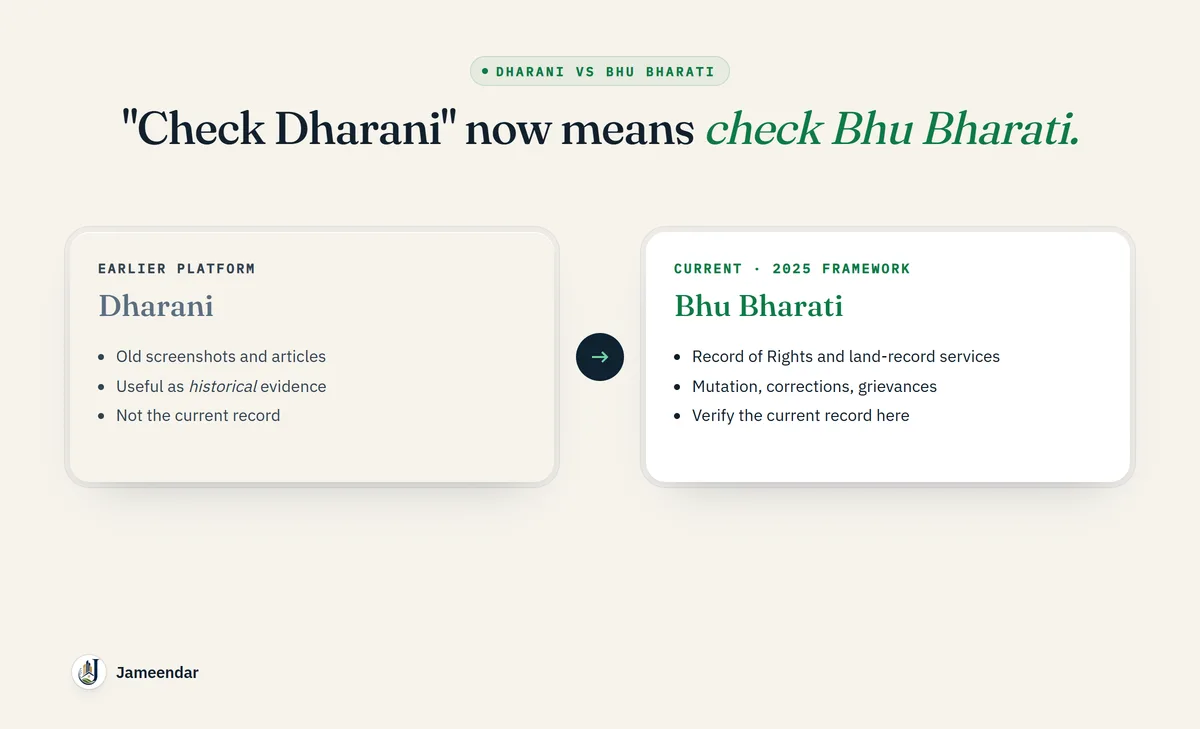
The Telangana government introduced the Bhu Bharati framework in 2025 for Record of Rights in Land and related land-record services.
Therefore, when an old document, broker message or online article tells you to “check Dharani,” translate that instruction into the current Bhu Bharati process and verify the current record there.
Old screenshots can still be useful as historical evidence, but they should not be treated as the current record.
What should a buyer check?
1. Current recorded owner/pattadar information
Compare the current land record with the seller's ownership documents.
2. Survey and sub-division
Make sure the record refers to the same parcel you are buying.
3. Extent
Compare the recorded extent with the deed and the physical property.
4. Mutation history/status where available
Understand whether a recent transaction has been reflected in the current record.
5. Prohibited-property status
A mutation check does not replace the prohibited-property check.
6. NALA/conversion history where relevant
If agricultural land is being sold for a non-agricultural use, investigate the applicable conversion/use status separately.
What does a pending mutation tell you?
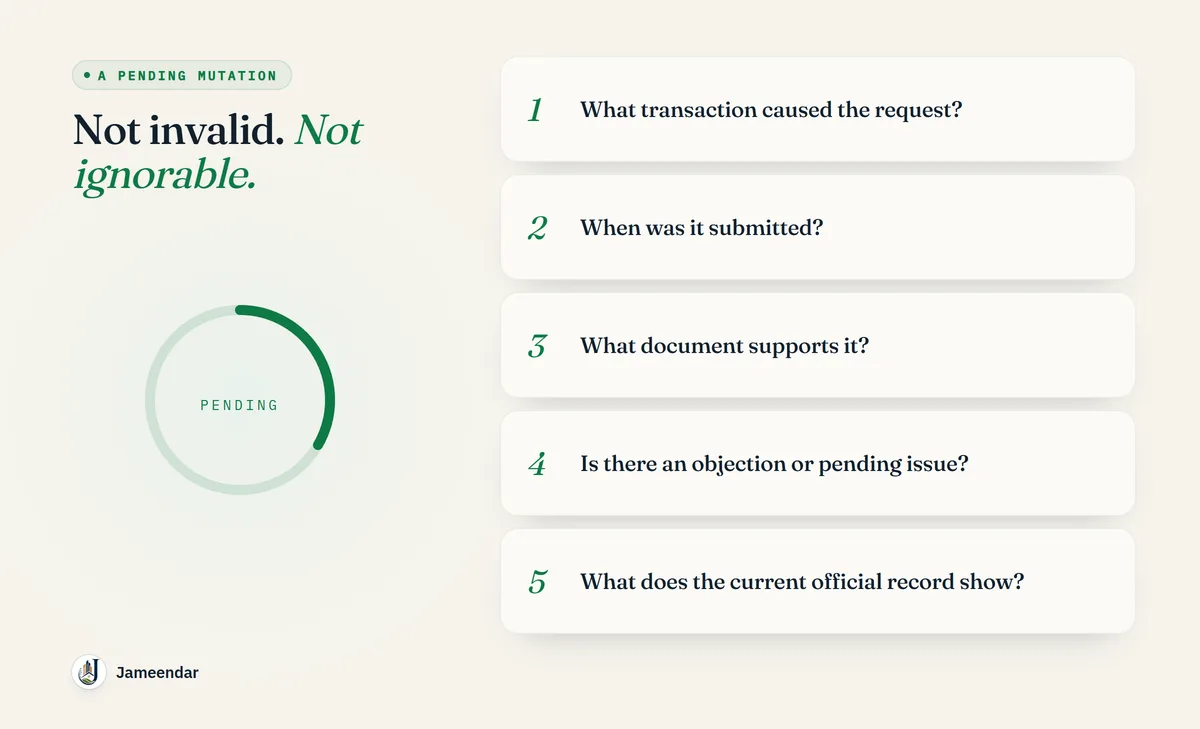
A pending update does not automatically mean the transaction is invalid. It means the revenue record may not yet reflect the expected change.
Ask:
- What transaction caused the mutation request?
- When was it submitted?
- What document supports it?
- Is there an objection or pending issue?
- What does the current official record actually show?
The answer should be documented.
What if the mutation record shows the previous owner?
Do not immediately conclude that the seller has no rights. The transaction may be recent or the mutation may be pending.
But do not ignore it either.
Reconcile the sale deed, registration history, current land record and mutation status. If the mismatch cannot be explained, obtain professional advice before proceeding.
What if the land record and sale deed disagree?
Create a discrepancy list and identify the exact issue.
For example:
| Issue | Possible verification step |
|---|---|
| Name mismatch | Compare title chain and identity/succession documents |
| Survey mismatch | Check survey/subdivision records |
| Extent mismatch | Check underlying land/survey records |
| Pending mutation | Review application/status and supporting deed |
| Prohibited entry | Check official prohibited-property workflow |
Do not “fix” the discrepancy by changing the agreement to match whichever record looks convenient.
How Bhu Bharati can help a buyer
The current Bhu Bharati portal provides citizen workflows for services including mutation-related processes, passbook data correction, prohibited-property grievances and other Record of Rights functions.
For buyers, the important point is that the portal is a current source of land-record information and service workflows. Use it together with registration records and the actual title documents.
Common mutation mistakes
Mistake 1: Treating mutation as title
Mutation is a record update, not a substitute for a legal title opinion.
Mistake 2: Using old Dharani screenshots
Always confirm the current Bhu Bharati record.
Mistake 3: Ignoring pending updates
A pending mutation can explain a mismatch, but you still need to understand why it is pending.
Mistake 4: Checking only the seller's screenshot
Verify the current record independently.
Mistake 5: Ignoring registration history
Mutation and registration records should be reconciled rather than substituted for each other.
FAQs
Is Dharani still the current land-record system?
For current Telangana land-record workflows, Bhu Bharati is the relevant current system under the 2025 framework. Old Dharani records may still appear in historical documents.
Does mutation prove ownership?
No. It is an important revenue-record update but should be considered alongside title documents and other evidence.
What if mutation is pending?
Find out why, review the supporting transaction and check whether there are objections or other issues. Seek professional advice if the mismatch is material.
Should I check Bhu Bharati and registration records?
Where relevant, yes. They provide different record layers.
Final buyer workflow
Current Bhu Bharati record → title deed → registration history → mutation status → survey/extent → prohibited-property status → physical property → legal review if needed.
The safest approach is not to ask whether mutation is “done” as a yes/no question. Ask whether the current land record, transaction history and physical property tell the same story.