How to Verify a Property Title in Telangana
Learn how to verify a property title in Telangana using the chain of title, registration history, EC, land records and supporting documents.
Jameendar Editorial · · 4 min read
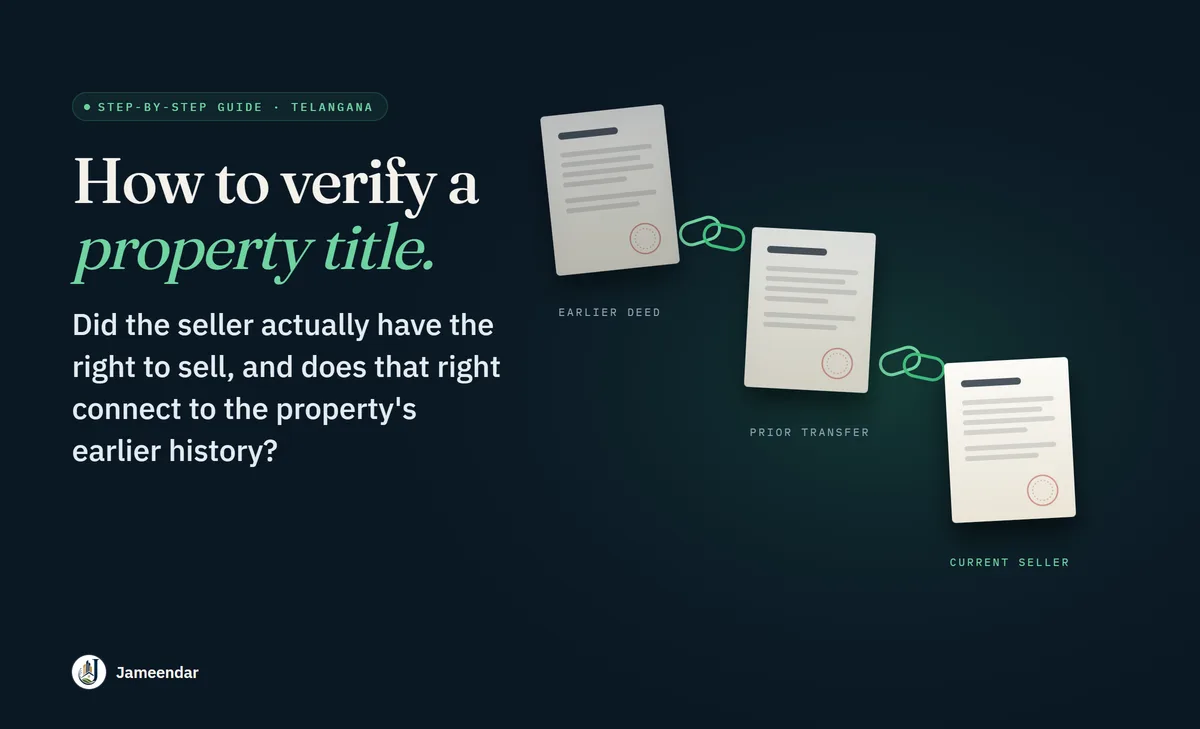
A sale deed tells you about a transaction. Property title verification in Telangana asks a bigger question: did the person who sold the property actually have the right to sell it, and does that right connect properly to the property's earlier history?
That distinction matters because a property can have a recent registered deed and still require questions about inheritance, partition, prior transfers, restrictions or other claims.
What title verification means
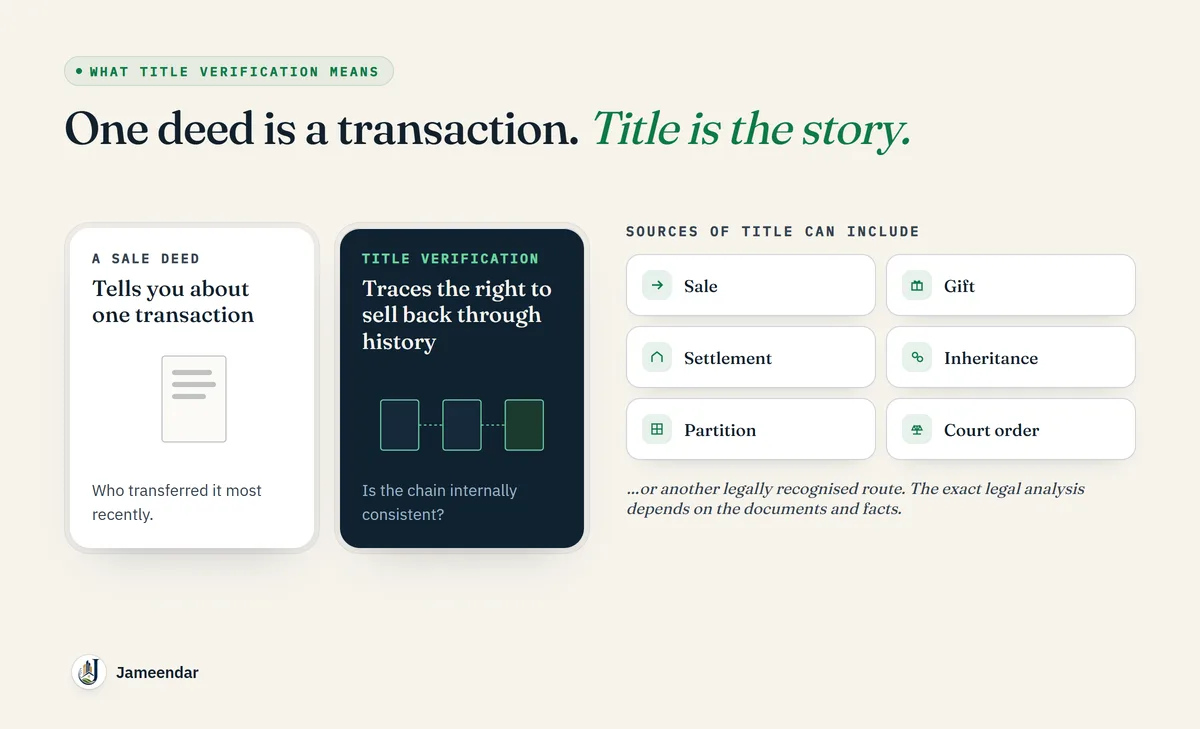
For a buyer, title verification is the process of tracing the legal basis for ownership and checking whether the chain is internally consistent.
The source of title may be a sale, gift, settlement, inheritance, partition, court order or another legally recognized route. The exact legal analysis depends on the documents and facts.
Step 1: Collect the chain of title
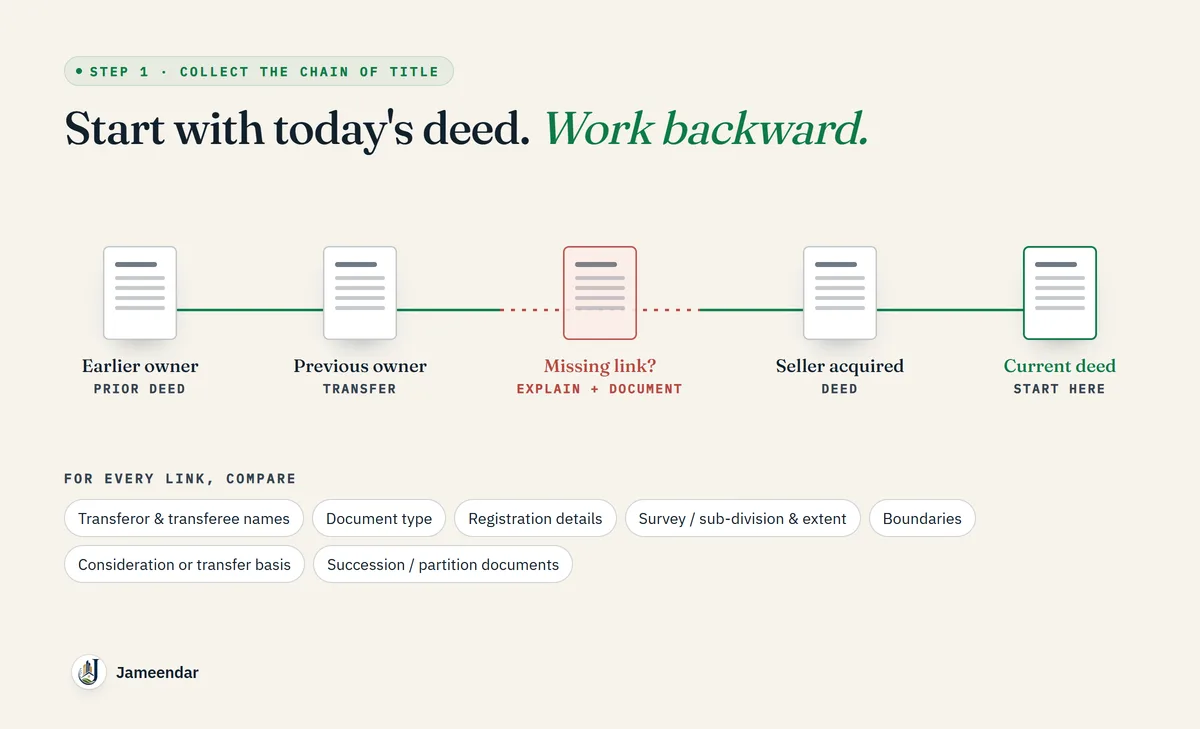
Start with the current deed and work backward through the relevant prior transactions.
For every link, compare:
- Names of transferor and transferee
- Document type
- Registration details
- Survey/sub-division and extent
- Property boundaries
- Consideration or transfer basis where relevant
- Supporting succession/partition documents where relevant
A missing link does not automatically prove defective title. It means the missing link needs to be explained and documented.
Step 2: Use the correct government systems
Telangana's property verification process can involve more than one record system.
Registration records: use the Telangana registration system for registered-document history and EC-related services.
Land/revenue records: Bhu Bharati is the current Telangana land-record platform under the 2025 Bhu Bharati framework. It replaced the earlier Dharani-era system for current land-record services.
If land moved from agricultural/revenue use into another use, do not assume the history exists in only one system.
Step 3: Use the EC as a cross-check
Compare EC entries with the documents in your title chain.
If the EC contains a mortgage, sale, release or other registered transaction you cannot reconcile, stop and obtain the underlying document.
A Nil EC only means the relevant search found no registered transactions in the chosen period. It is not a complete title opinion.
Step 4: Check current mutation/land-record information where relevant
Mutation updates revenue records following a transfer or another event. It is useful as an independent cross-check, especially for land with agricultural/revenue history.
Do not treat mutation alone as conclusive proof of title. Instead, ask whether the current record is consistent with the title documents and transaction history.
Step 5: Check restrictions
A title chain should be reviewed alongside restrictions that can affect registration or transfer.
Telangana's official systems provide prohibited-property workflows. If the property appears on a prohibited list, do not assume the sale deed automatically overcomes that restriction.
This is a point where professional review is especially important because the reason for the restriction matters.
Step 6: Match survey number, extent and boundaries
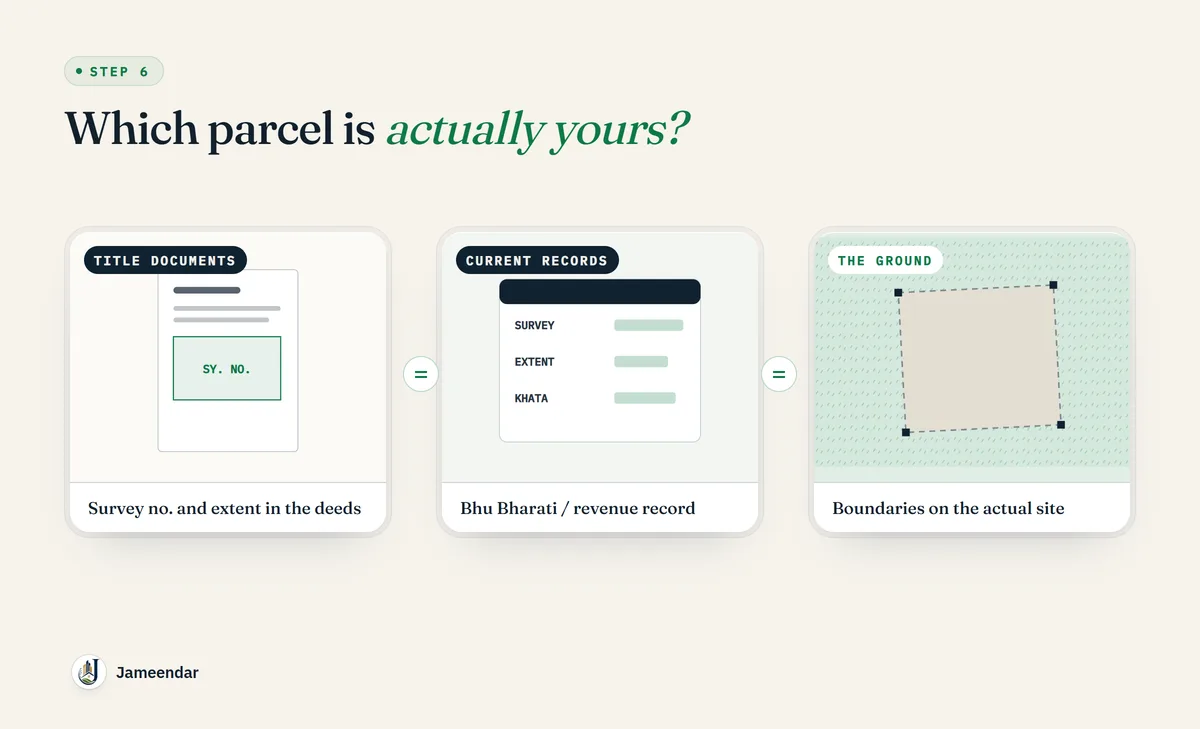
Title is about rights to a property, but the buyer must also identify exactly which physical parcel those rights relate to.
Compare the survey/sub-division and extent in the title documents with current records and then compare them with the ground reality.
Step 7: Check supporting documents for unusual ownership histories
Additional review may be needed where the chain includes:
- Inheritance
- Will or succession
- Partition
- Family settlement
- Gift/settlement
- POA
- Court decree
- Government assignment
- Conversion or change in land use
The more unusual the chain, the less sensible it is to rely on a checklist alone.
Step 8: Obtain a lawyer's title opinion for material purchases
A title opinion should be based on the actual documents, not screenshots or a broker's summary.
Ask the lawyer to identify missing links, restrictions, unresolved claims and documents that should be obtained before registration.
Common title-verification mistakes
Looking only at the latest deed
The latest deed is one link in the story.
Assuming registration equals perfect title
Registration is important, but it does not eliminate every possible legal issue.
Treating mutation as title
Mutation is a revenue-record function and should be used as a cross-check.
Treating Nil EC as “no problem”
The EC is narrower than a full title review.
Ignoring the physical property
A legal description must still be matched to the actual parcel.
A practical title-review table
| Evidence | Main question |
|---|---|
| Current sale deed | Who transferred the property most recently? |
| Earlier deeds | How did ownership move? |
| EC | What registered transactions appear in the searched period? |
| Bhu Bharati/revenue record | What current land record information is shown? |
| Tax records | Does the occupier/owner information align? |
| Survey/boundary evidence | Does the paper property match the ground? |
| Restrictions | Is registration/transfer affected? |
| Legal opinion | Are the documents legally consistent? |
FAQs
How many years of title documents should I collect?
There is no universal number that replaces legal judgment. Collect the chain necessary to explain how the current seller acquired the property, and follow the period your lawyer or lender requires.
Is an EC enough to verify title?
No.
Is Bhu Bharati the same as the registration record?
No. They are different record layers with different purposes.
When should I hire a lawyer?
Whenever the chain includes inheritance, POA, partition, court orders, assignment, disputes or unexplained gaps.
Final takeaway
Title verification is not a document-counting exercise. It is a consistency test: seller → title chain → registration history → land records → restrictions → physical property → legal opinion.
Jameendar can help buyers organize property information and verification signals. For a transaction-specific title conclusion, use a qualified property lawyer.