Section 22-A in Telangana: What Property Buyers Must Check
Understand Section 22-A and prohibited-property checks in Telangana, what buyers should verify and what to do when records conflict.
Jameendar Editorial · · 4 min read
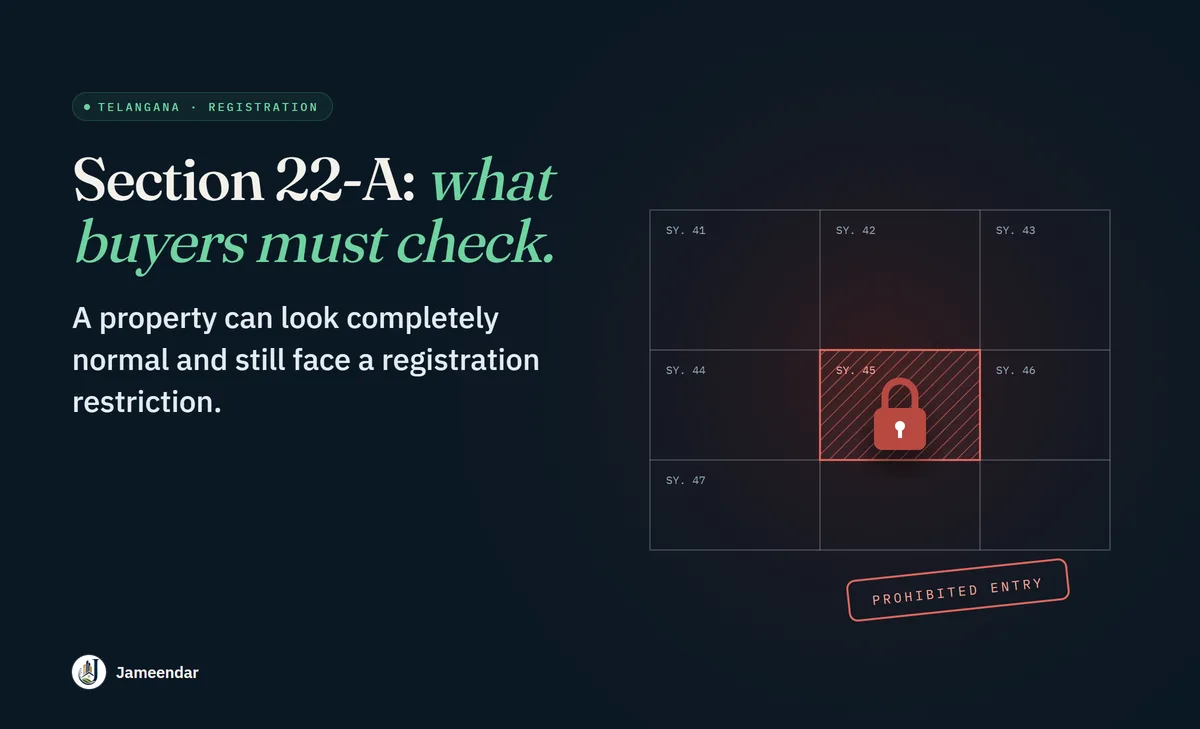
A property can look completely normal to a buyer and still face a registration restriction because the relevant land or survey number appears in a prohibited-property record.
That is why Section 22-A deserves its own check in Telangana property due diligence.
What does Section 22-A mean for a buyer?
Section 22-A of the registration framework is associated with categories of properties for which registration is restricted/prohibited under the applicable law and notifications.
For a buyer, the practical lesson is more important than the legal shorthand:
Do not assume that a seller's title documents are enough. Check whether the property is affected by a prohibited-property entry before you commit money.
Why this check is separate from title verification
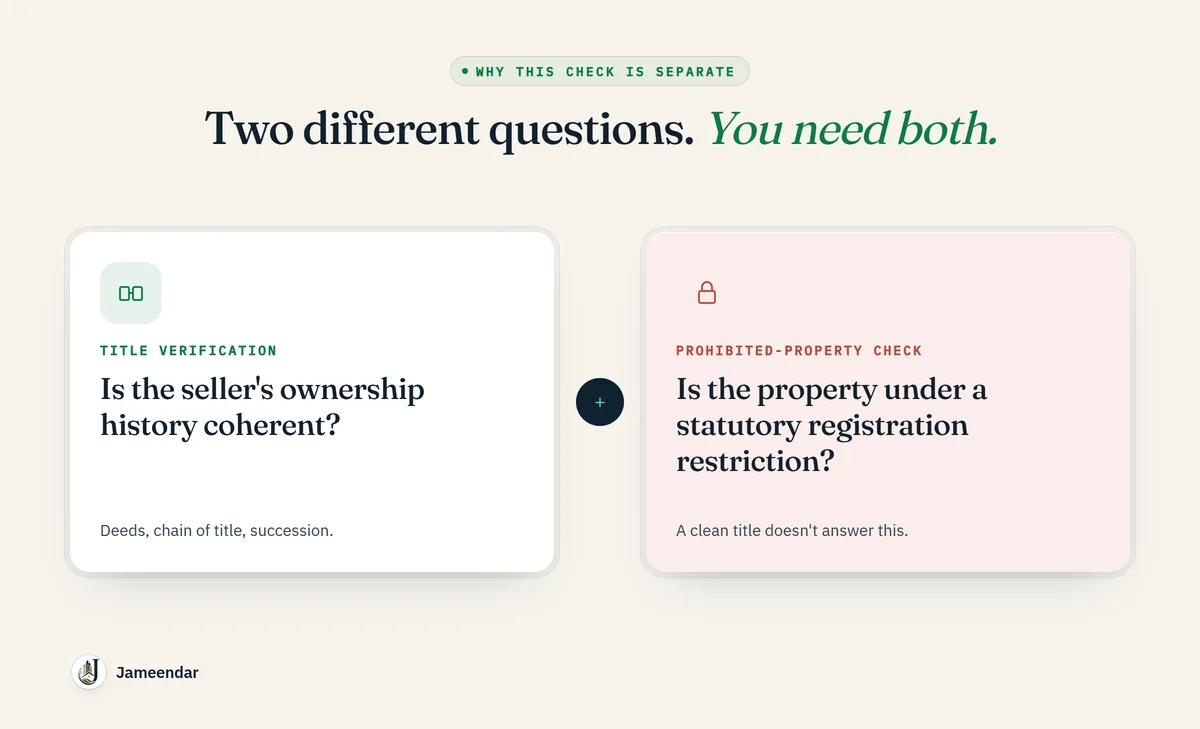
Title verification asks whether the seller's ownership history is coherent.
A prohibited-property check asks whether the property is subject to a statutory registration restriction.
A buyer needs both.
What should you check?
Start with the exact identifiers:
- District
- Mandal/local jurisdiction where relevant
- Village/locality
- Survey number
- Sub-division
- Extent
- Plot/property description
The more precisely you identify the property, the less likely you are to investigate the wrong parcel.
Check the official records
Bhu Bharati provides an official prohibited-properties workflow for land records. The Telangana registration system also has registration-related property services and restrictions.
Do not rely on a broker's screenshot or a search result copied into WhatsApp. Open the current official source and check the property identifiers yourself where possible.
What if the property appears on the list?
Stop the purchase process until you understand why.
Ask:
- What is the reason for the entry?
- Which survey/sub-division is affected?
- Is the entire survey number affected or only an extent/portion?
- Is there a government order or proceeding supporting the entry?
- Has any correction/removal process been initiated?
- Is there a court order relevant to the status?
Do not assume that “the seller has already applied to remove it” means the issue is resolved.
What if the seller says it is a mistake?
It may be a mistake. Telangana's Bhu Bharati system provides a grievance route for inclusion in the prohibited-properties list.
But a pending grievance is not the same as a completed correction.
Ask for the actual status and supporting order before treating the issue as resolved.
What if the deed is already registered?
A historical registration is evidence of a past transaction. It does not automatically answer whether the current property is presently free from a registration restriction.
This is one reason buyers should check current records rather than relying solely on old deeds.
What if Bhu Bharati and registration records disagree?
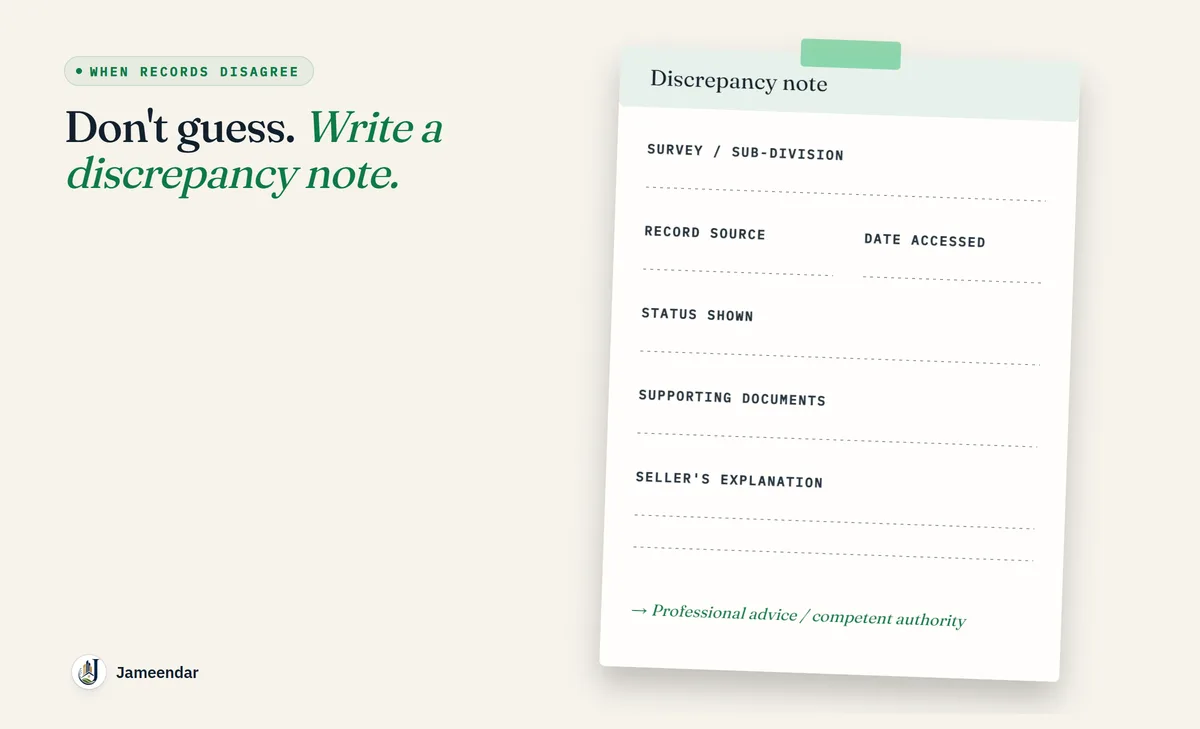
Do not guess.
Create a discrepancy note containing:
- exact survey/sub-division;
- record source;
- date accessed;
- status shown;
- supporting documents available; and
- explanation given by the seller.
Then obtain professional advice and, where required, clarification from the competent authority.
Common mistakes
Mistake 1: Checking only after paying the advance
This reverses the sensible order.
Mistake 2: Searching only the plot number
The underlying survey/sub-division may be critical.
Mistake 3: Assuming private ownership defeats the restriction
The relevant legal classification must be understood.
Mistake 4: Treating a pending correction as a clean record
Wait for the actual status/order.
Mistake 5: Using old articles as current guidance
Telangana's land-record systems and workflows have changed. Use current official portals.
Practical buyer checklist
- ☐ Exact survey/sub-division collected
- ☐ Current prohibited-property status checked
- ☐ Reason for any restriction understood
- ☐ Underlying order/document obtained where necessary
- ☐ Bhu Bharati and registration information compared
- ☐ Seller explanation independently verified
- ☐ Lawyer consulted for material disputes
- ☐ No advance paid while a material restriction remains unresolved
FAQs
Is every property on a prohibited list automatically fraudulent?
No. An entry can arise from different legal or administrative circumstances. The key question is what the entry means for the specific property and transaction.
Can a prohibited-property entry be corrected?
The official Bhu Bharati system provides a grievance process for inclusion in the prohibited-properties list. A buyer should verify the actual status rather than rely on a promise of future correction.
Does a clean title mean Section 22-A is not a problem?
No. Check the restriction separately.
Should I pay a token advance while removal is pending?
For a material unresolved restriction, the safer approach is to obtain legal advice and resolve the issue before committing funds.
Final takeaway
Section 22-A is not a technical footnote. It is a practical pre-purchase check.
Identify the exact parcel → check the current official status → understand any restriction → verify corrections/orders → obtain legal advice where needed → only then proceed.