How to Verify a Property Before Buying in Hyderabad
A practical guide to verifying a property before buying in Hyderabad — ownership, title, EC, survey records, restrictions and approvals.
Jameendar Editorial · · 6 min read
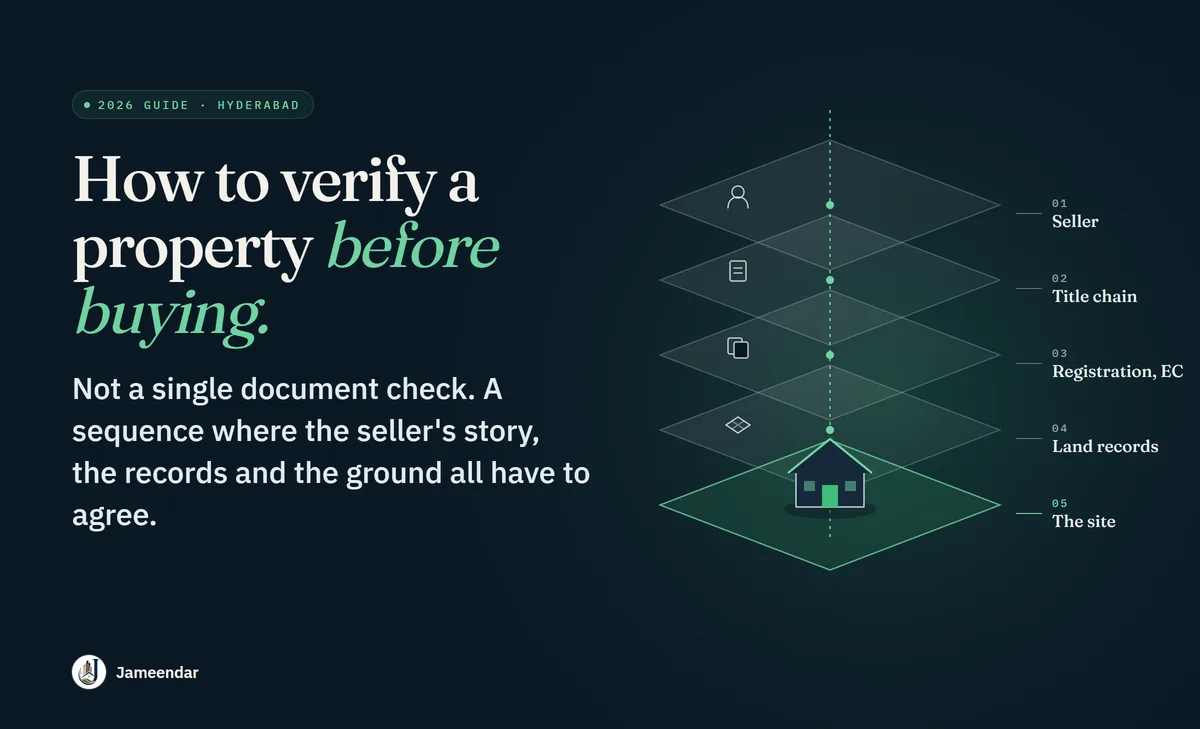
Buying property in Hyderabad is not just about finding the right location and negotiating the right price. The harder question is whether the property you are buying is actually what the documents say it is.
A seller may show you a sale deed, an EC, tax receipts and a layout plan. That still does not mean every important question has been answered. Ownership, title history, registration records, land records, survey boundaries, prohibited-property status and development approvals answer different questions.
The safest approach is to treat verification as a sequence rather than a single document check.
The short answer
Before buying, verify:
- The seller is entitled to sell.
- The chain of title makes sense.
- Registered transactions match the documents shown to you.
- The EC has been checked for an appropriate period and is not treated as a title certificate.
- Current land/revenue records are consistent with the transaction history.
- Prohibited-property/Section 22-A status has been checked.
- Survey number, extent and physical boundaries match.
- Layout, building, RERA and occupancy approvals are checked separately where applicable.
- Location-specific restrictions are investigated.
- Only then should you negotiate final terms or pay an advance.
Step 1: Verify the seller is entitled to sell
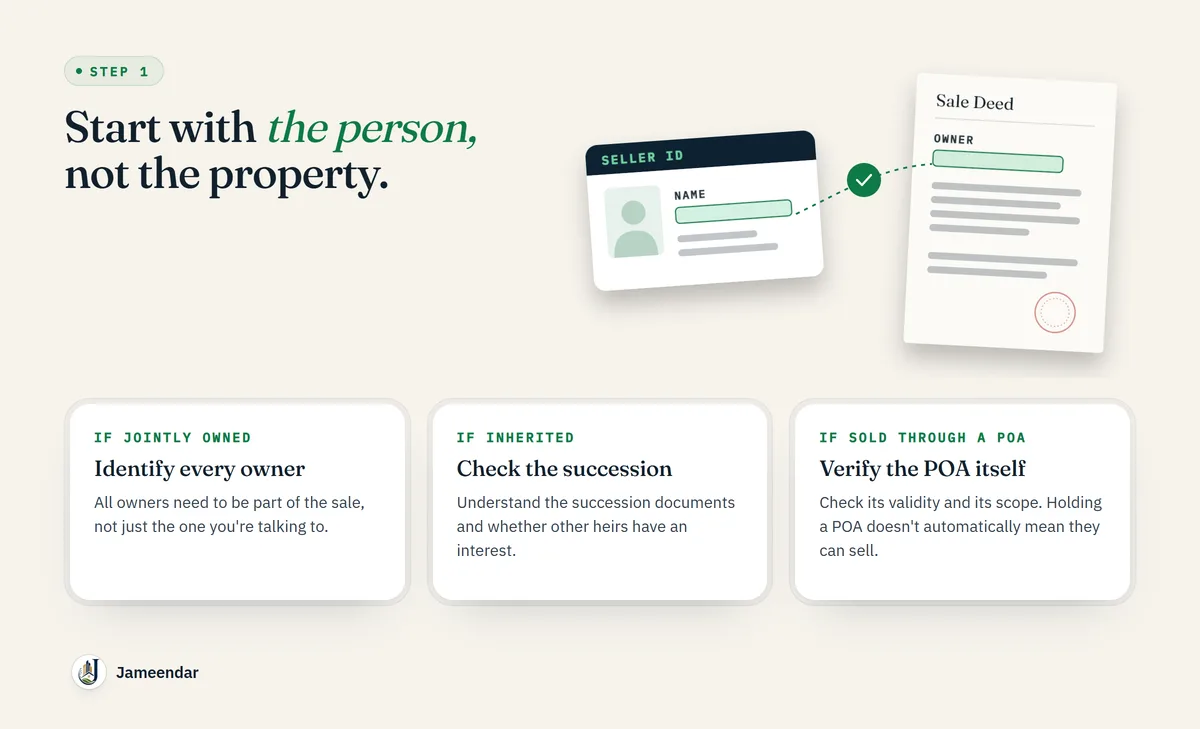
Start with the person, not the property.
Match the seller's identity with the name appearing in the title document. If the property is jointly owned, identify all owners. If it came through inheritance, understand the succession documents and whether other heirs have an interest. If a Power of Attorney is involved, verify the POA itself and its scope rather than assuming the person holding it can automatically sell.
A name mismatch is not automatically fraud. But it is a reason to stop and obtain a documented explanation before money changes hands.
Step 2: Build the chain of title
Do not review only the latest sale deed. Trace how the property reached the current seller.
For each transaction, ask:
- Who transferred the property?
- Who acquired it?
- What document created the transfer?
- Does the property description remain consistent?
- Does the extent remain consistent?
- Are there inheritance, partition, gift, settlement or court documents involved?
The purpose is not to collect the largest possible pile of documents. It is to identify whether the ownership story has an unexplained gap.
Step 3: Check registration history
Registered-document history is a separate verification layer. Telangana's registration system is used for registered documents and related registration services.
Compare what you find in the registration record with the seller's document chain. If the official record contains a transaction that the seller did not mention, obtain the underlying document and understand it before proceeding.
Step 4: Get the EC — but do not treat it as a title certificate
An Encumbrance Certificate is useful because it reports registered transactions found for the searched period. A Nil EC means no registered transaction was found within that search window.
It does not prove that every possible claim has disappeared. Unregistered arrangements, some litigation situations and events outside the searched period may not appear in the EC.
The correct question is therefore not “Is the EC clean?” but “Does the EC agree with the title history and the other records I have reviewed?”
Step 5: Check Bhu Bharati/current land records
For land with agricultural or revenue-record history, check the current Telangana land-record system, Bhu Bharati. Telangana's Bhu Bharati framework came into force in 2025 and replaced the earlier Dharani-era workflow for current land-record services.
Use the relevant survey, sub-division, khata and location information to compare the record with the documents supplied by the seller.
Do not assume that the registration record and land record are interchangeable. They are different evidence layers.
Step 6: Check Section 22-A and prohibited-property status
A property can have a convincing-looking document chain and still face a registration restriction.
Check the relevant prohibited-property status using the current official systems. For land records, Bhu Bharati provides a prohibited-properties workflow; registration-related checks should also be made through the appropriate registration system.
If a record conflict appears, do not try to “solve” it by relying on a broker's assurance. Obtain the underlying government record and professional advice before proceeding.
Step 7: Verify the property on the ground
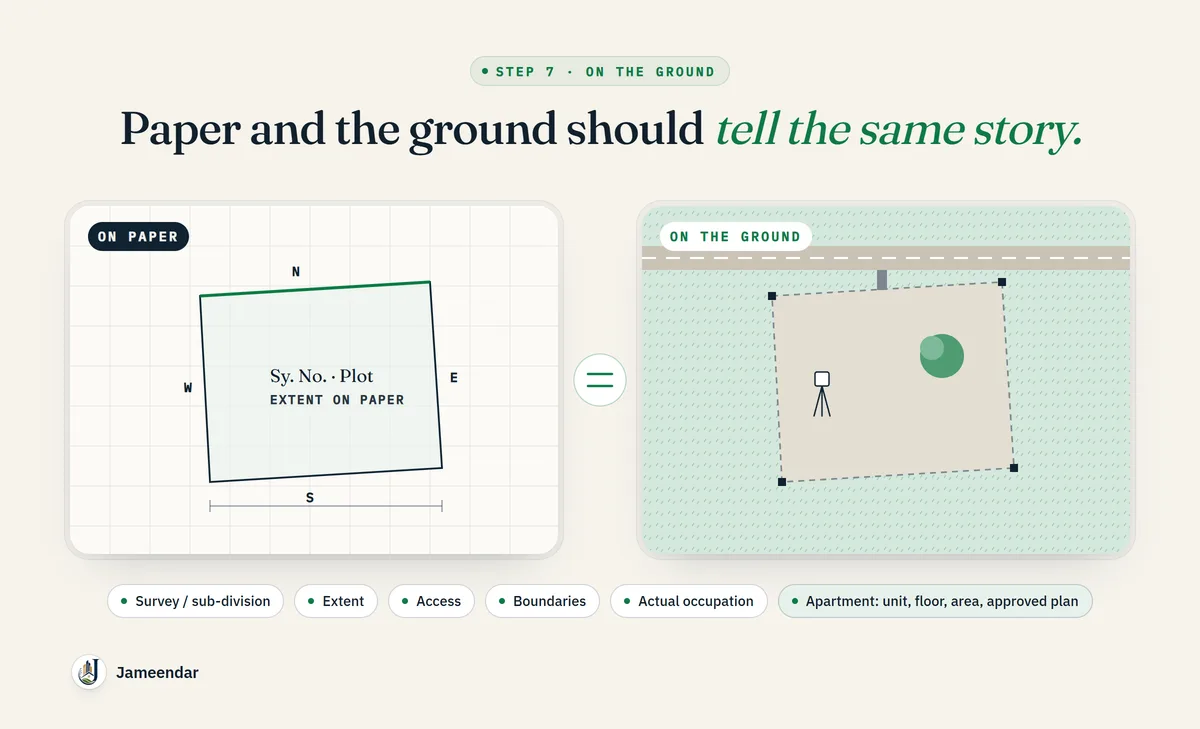
Take the documents to the site.
Confirm the survey/sub-division, extent, access, boundaries and actual occupation. For a plot, an independent survey can be valuable. For an apartment, compare the unit, floor, carpet/built-up descriptions and approved plan where relevant.
Paper and physical reality should tell the same story.
Step 8: Separate approvals instead of treating “approved” as one status
For a developed property, ask which approval you are actually being shown.
- Layout approval: concerns the layout/development of land.
- Building permission: concerns construction of a building.
- TG RERA registration: concerns a real-estate project where applicable.
- Completion Certificate: relates to completion of construction under the applicable process.
- Occupancy Certificate: concerns permission/approval for occupation under the applicable authority and process.
These are not interchangeable. HMDA currently states that building permissions, occupancy certificates and layout permissions within its relevant jurisdiction are processed through TG-bPASS, subject to the stated exceptions.
Step 9: Check location-based restrictions
A clean title does not answer every location question.
Depending on the site, investigate issues such as lake/FTL or buffer concerns, nalas, catchments, land-use restrictions, road widening, master-plan reservations and other planning constraints.
Do not accept a blanket statement such as “HYDRAA has cleared this” unless you have an authoritative record supporting that specific property.
Step 10: Negotiate and pay only after verification
Once the verification picture is reasonably clear, you can negotiate from a stronger position.
If you do pay a token advance, put the property description, amount, date, parties and refund/cancellation terms in writing. A token advance is not a substitute for a sale deed and does not itself prove title.
A practical buyer checklist
| Check | Done? |
|---|---|
| Seller identity and authority | ☐ |
| Chain of title | ☐ |
| Registration history | ☐ |
| EC | ☐ |
| Bhu Bharati/revenue records where relevant | ☐ |
| Prohibited-property status | ☐ |
| Survey and boundaries | ☐ |
| Layout/building approvals | ☐ |
| RERA where applicable | ☐ |
| OC/CC where applicable | ☐ |
| Location restrictions | ☐ |
| Independent legal/site review | ☐ |
When should you walk away?
Pause the transaction when the seller refuses to share essential documents, ownership cannot be reconciled, survey details do not match, a prohibited-property issue is unexplained, a mortgage or transaction appears without supporting paperwork, or you are being pressured to pay before verification.
A good property does not become worse because you ask questions. Pressure to stop asking questions is itself useful information.
Can you verify a property completely online?
No. Many important checks can start online, but physical boundaries, construction, possession and document interpretation may require an in-person inspection or professional review.
FAQs
What should I check first?
Start with seller identity and authority. If the person cannot establish the right to sell, the rest of the review is premature.
Is a Nil EC enough?
No. It only tells you what the searched EC found for the selected period. Use it with the title chain and other records.
Should I check Bhu Bharati and registration records?
Where the property's history makes both relevant, yes. They answer different questions.
When should I hire a lawyer?
Before paying an advance when inheritance, POA, partition, litigation, unusual land history or conflicting records are involved.
Final thought
Property verification is not about finding a single “magic document.” It is about making the seller's story, government records, documents and physical property agree with each other.
Check the property. Understand the documents. Then decide.
Jameendar can help buyers organize property information, verification signals and price/risk intelligence. Use those tools as decision support, not as a substitute for a qualified lawyer's opinion on a specific transaction.