How to Identify Property Fraud: 15 Red Flags
15 practical property-fraud red flags for Hyderabad buyers, from document inconsistencies and fake urgency to ownership and payment risks.
Jameendar Editorial · · 3 min read
Property fraud in Hyderabad rarely looks like a dramatic scam. More often, it looks like a normal transaction with one missing document, one unexplained name mismatch or one request to “pay today and we will fix the paperwork tomorrow.”
A red flag is not proof of fraud. It is a reason to stop, verify and demand evidence.
15 red flags buyers should take seriously
1. The seller refuses to share core documents
If you cannot review the basic title and property documents before paying, pause the deal.
2. The seller's name does not match the ownership document
A variation may have an explanation. Ask for documentary proof.
3. “Originals are not available” becomes the permanent answer
Copies can be useful for initial review, but important transactions require proper document verification.
4. The seller's story changes
If the acquisition story changes when you ask for supporting documents, investigate.
5. An unexplained Power of Attorney appears
Verify who granted it, what it authorizes and whether it remains valid.
6. Inherited property has unexplained heirs
If several family members could have an interest, identify how that interest was dealt with.
7. EC entries do not match the seller's story
Obtain the underlying documents. Do not accept a verbal explanation.
8. Survey number or extent changes between documents
This is a major verification point because it can affect the identity of the property itself.
9. The property appears on a prohibited-property list
Stop and understand the restriction before considering registration.
10. The broker says government records are unnecessary
Independent verification is part of the buyer's job, not an optional courtesy.
11. The buyer is pressured to pay before verification
Urgency is not evidence of a good deal.
12. Payment is requested to an unrelated account
Make sure the payment recipient is contractually and legally connected to the transaction.
13. A “guaranteed approval” is promised without documents
Ask for the actual approval, authority and reference details.
14. Physical boundaries do not match the paperwork
Stop until the parcel is properly identified.
15. Refund terms are deliberately avoided
If an advance is requested, put the conditions and refund/cancellation terms in writing before payment.
The strongest fraud detector: consistency
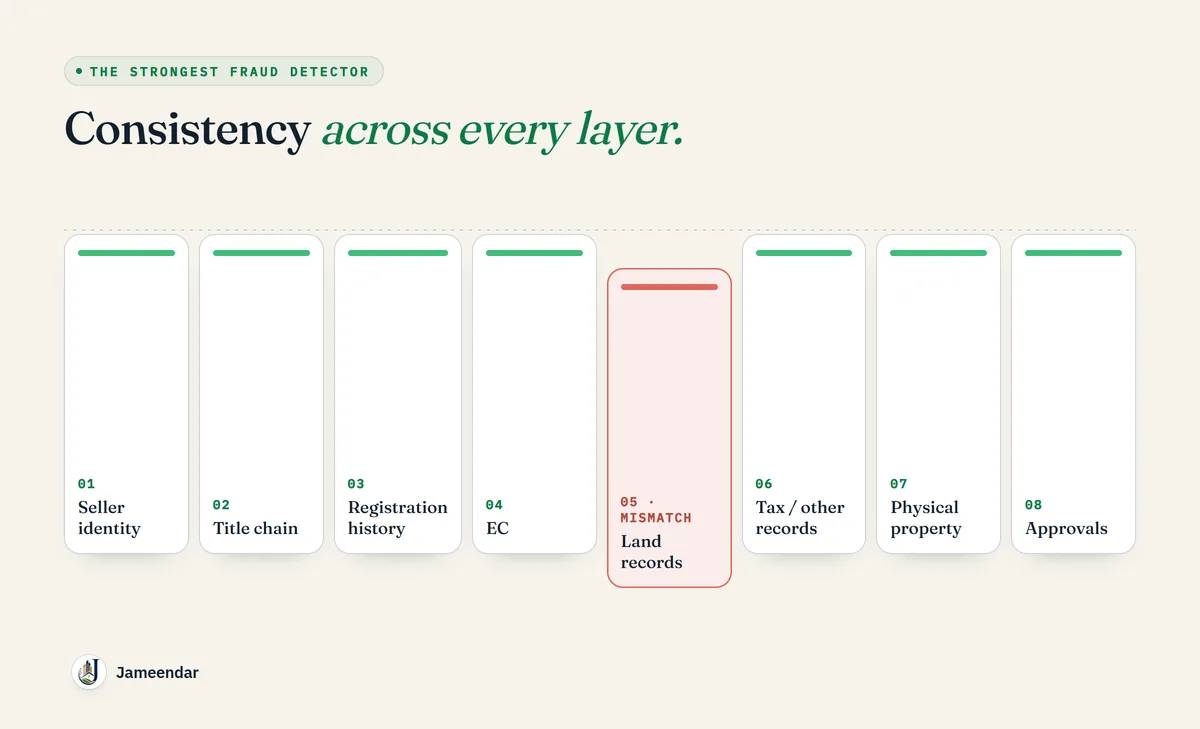
One document can be forged or misunderstood. A stronger approach is to compare multiple independent layers:
Seller identity → title chain → registration history → EC → land records → tax/other records → physical property → approvals.
Fraud and serious documentation problems often reveal themselves through inconsistency between these layers.
What should you do when you see a red flag?
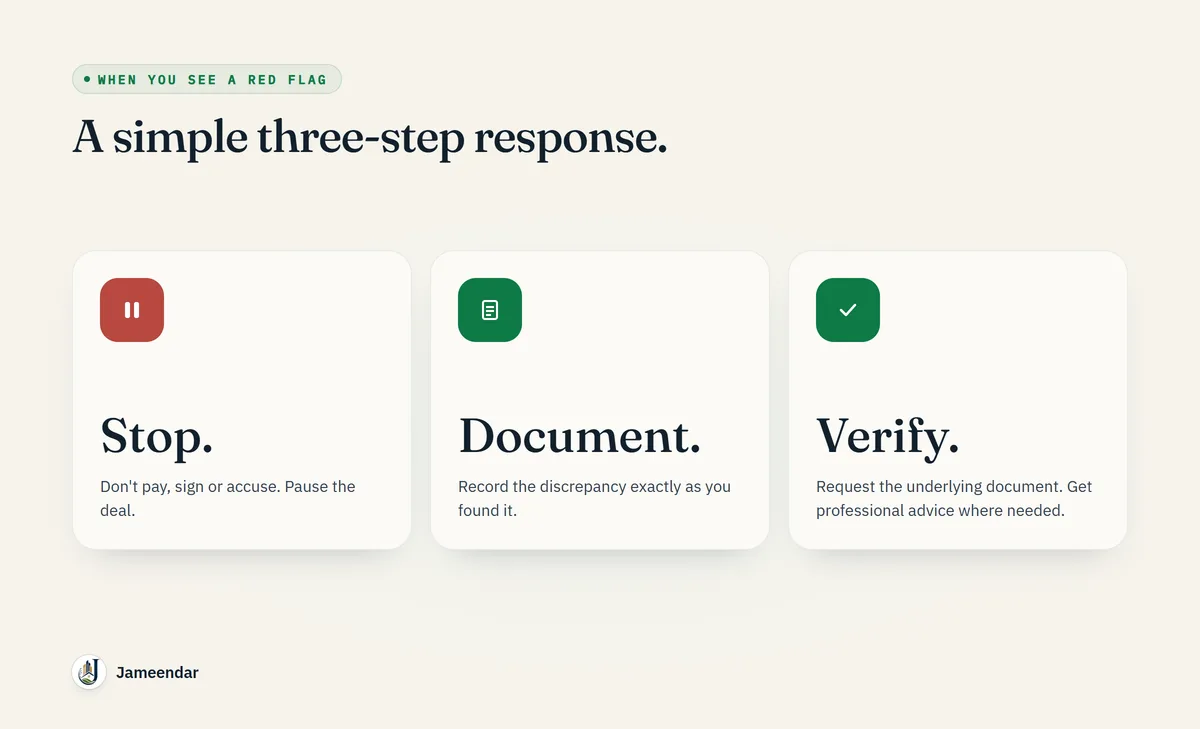
Use a simple three-step response:
Stop. Document. Verify.
Do not immediately accuse the seller. Record the discrepancy, request the underlying document and seek professional advice where necessary.
Red flag vs deal-breaker
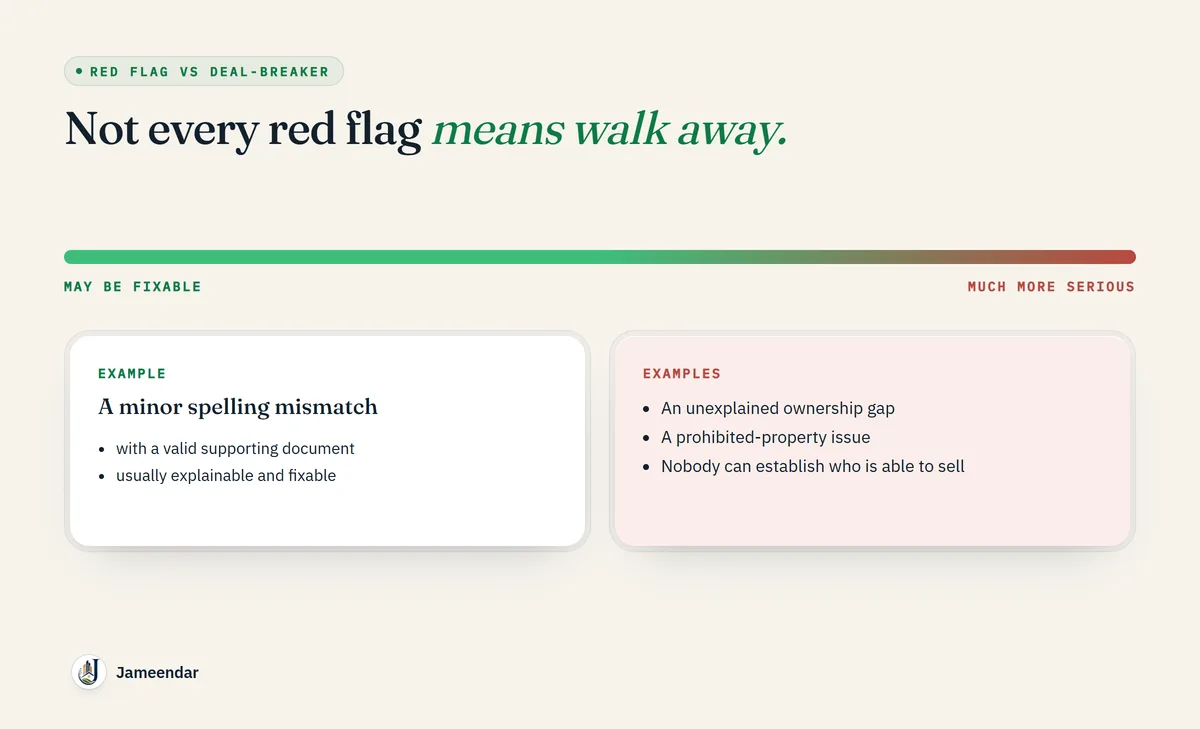
Not every red flag means you must walk away.
A minor spelling mismatch with a valid supporting document may be fixable. An unexplained ownership gap, prohibited-property issue or inability to establish who can sell may be much more serious.
The correct response depends on what the evidence shows.
FAQs
What is the biggest property fraud red flag?
A combination of document inconsistencies and pressure to pay before verification is particularly concerning.
Can a clean EC eliminate fraud risk?
No. EC covers registered transactions within the searched period; it is only one part of due diligence.
What if the seller says the issue will be fixed after registration?
Do not rely on that promise. Resolve material issues before committing money or signing documents.
Should I confront the seller about a red flag?
Ask for evidence calmly. For significant discrepancies, involve a lawyer rather than relying on an argument with the seller.
Final checklist
Before payment, ask whether you have independently confirmed:
- Who owns the property
- How ownership was acquired
- What the title chain shows
- What the EC shows
- What the current land records show
- Whether restrictions apply
- Whether the physical property matches
- Whether approvals are genuine and applicable
- Who will receive your money
- What happens if the transaction fails
The goal is not to prove that every seller is suspicious. The goal is to make the property difficult to misrepresent.