25 Checks to Complete Before Paying a Property Token Advance
A practical pre-advance checklist for Hyderabad property buyers covering ownership, title, records, approvals, dues and the token receipt.
Jameendar Editorial · · 4 min read
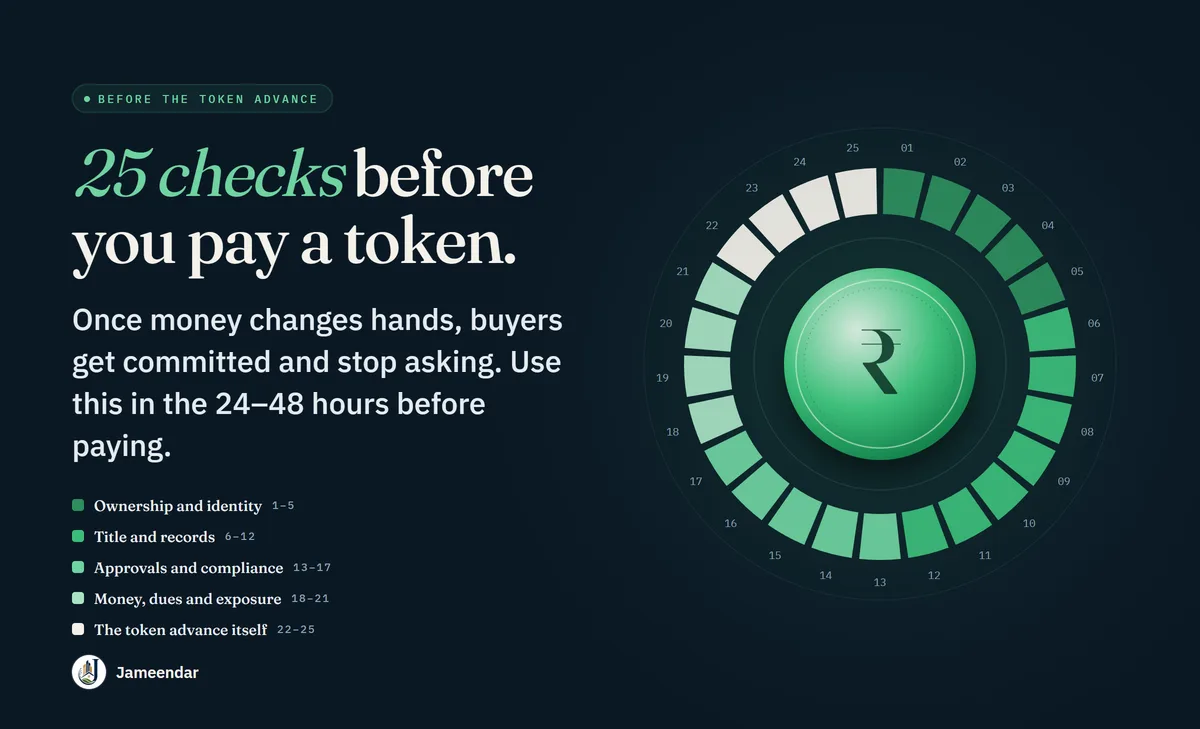
A token advance can feel harmless because it is usually much smaller than the purchase price. But once money changes hands, buyers often become psychologically committed to the deal and start overlooking problems they would have questioned earlier.
Use this property buying checklist in the 24–48 hours before paying an advance on a Hyderabad home or plot. Not every check applies identically to every apartment, plot or villa, but every skipped item should be a conscious decision.
Ownership and identity
1. Seller identity matches the title document
Match the seller's legal name with the relevant title document and identity proof. Documented name variations should be explained.
2. All owners are identified
If the property is jointly owned, identify all co-owners and understand who must sign.
3. Inheritance is properly documented
For inherited property, ask for the succession, will, probate/court documents or other relevant records as applicable. Do not assume one heir automatically represents every interested person.
4. Power of Attorney is checked
If someone is acting under POA, verify the document, its scope and validity with professional help where necessary.
5. Seller's story is consistent
Ask how the seller acquired the property. Compare the answer with the documents.
Title and records
6. Chain of title has been reviewed
Do not stop at the latest sale deed. Trace the relevant previous transfers.
7. EC has been checked
Pull an EC for an appropriate period and compare its transactions with the title chain. A Nil EC is not a blanket clear-title certificate.
8. Survey and sub-division numbers match
Check the same identifiers across the agreement, title documents and relevant land records.
9. Prohibited-property status is checked
Check the relevant official prohibited-property records before committing funds.
10. Land classification is understood
Know whether the property has agricultural/revenue history, conversion issues or other land-use considerations.
11. Mutation/current record is checked where relevant
The current revenue record should not be ignored when the property has agricultural or revenue-land history.
12. Physical boundaries are checked
The document description and the site should match in extent, access and boundaries.
Approvals and compliance
13. Layout approval is identified
For a plotted development, determine whether the layout is approved and by which authority.
14. Building permission is identified
For a constructed property, check the sanctioned building permission and relevant plan.
15. RERA registration is checked where applicable
Use the official TG RERA database for project information where the project falls within its scope.
16. Completion/occupancy documents are checked where applicable
For completed construction, distinguish Completion Certificate from Occupancy Certificate and check the applicable authority's record.
17. Location restrictions are investigated
For sites near lakes, nalas, catchments or other sensitive areas, conduct the appropriate location-specific checks.
Money, dues and exposure
18. Property tax is checked
Identify outstanding tax or municipal dues and agree who will clear them.
19. Utility dues are checked
Ask for current electricity/water statements where applicable.
20. Loans or mortgages are checked
Cross-check registered encumbrances and ask for bank-release documentation where a loan exists.
21. Apartment association dues are checked
For resale apartments, confirm maintenance and other association dues.
The token advance itself
22. Get a written receipt
The receipt should identify the parties, amount, date and property clearly.
23. Understand what the advance does
A token advance does not transfer ownership. It is not a substitute for a registered sale deed.
24. Put refund terms in writing
Specify what happens if verification reveals a material issue or if either party withdraws.
25. Do not let pressure replace verification
“Pay today or the property goes to someone else” is not a verification method. If essential checks remain incomplete, pause.
What should the receipt contain?
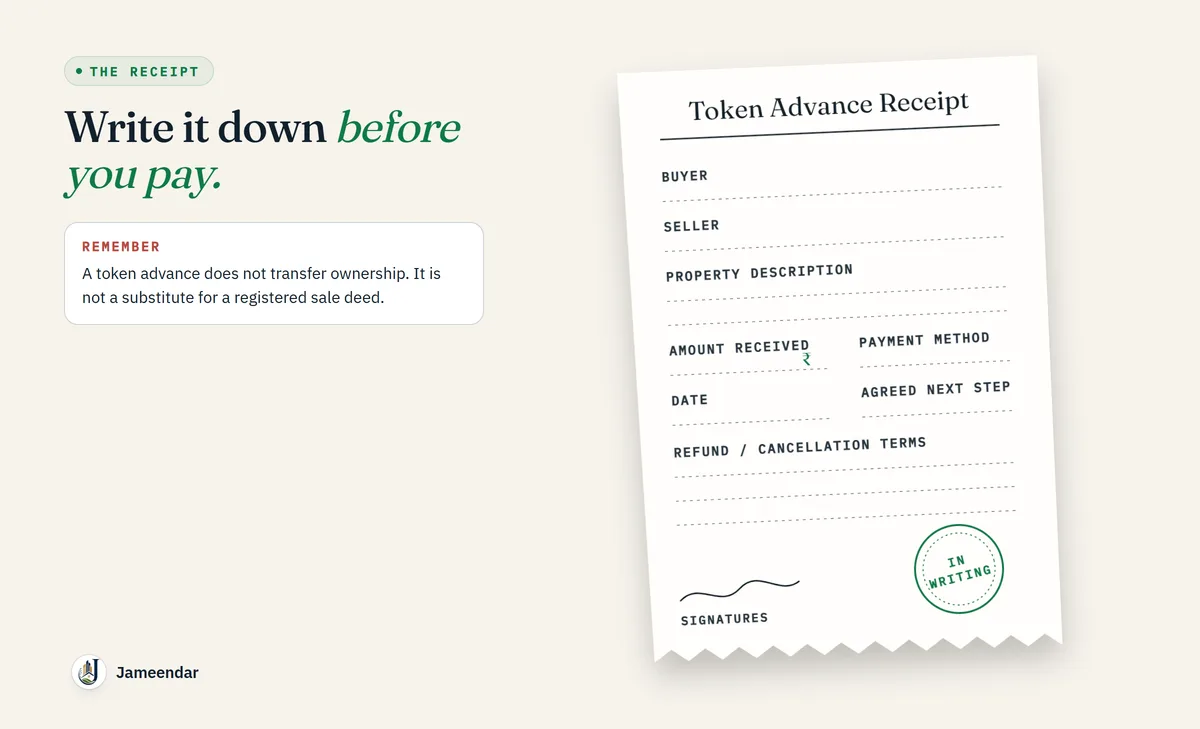
At minimum, identify the buyer and seller, property description, amount received, payment method, date and the agreed next step. The exact legal wording should be reviewed for the transaction.
The important principle is simple: do not rely on a verbal promise that the advance will be returned if something goes wrong. Write the terms down before payment.
The 5-minute stop test
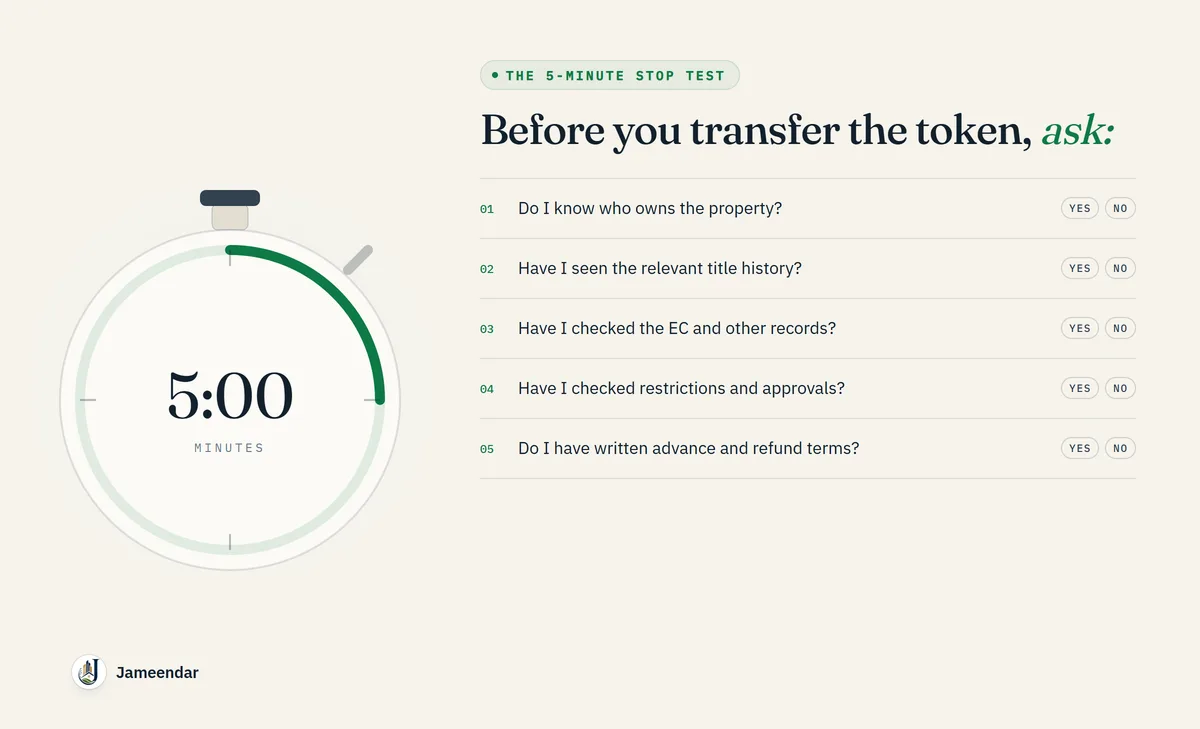
Before transferring the token, ask:
- Do I know who owns the property?
- Have I seen the relevant title history?
- Have I checked the EC and other records?
- Have I checked restrictions and approvals?
- Do I have written advance/refund terms?
If the answer to several is “no,” you are not ready to pay.
Red flags that should slow you down
- Seller refuses to share documents.
- Originals are always “with someone else.”
- Survey number changes between documents.
- A mortgage appears without a release document.
- Seller says “registration will sort it out later.”
- Buyer is asked to pay into an unrelated person's account.
- Refund terms are refused.
- A broker says legal verification is unnecessary.
FAQs
What should I check first?
Ownership and seller authority.
Can I pay a small token before verification?
You can make that commercial decision, but it increases your exposure. Complete material checks first whenever possible.
Does a token advance give me ownership?
No. It is not a registered transfer of ownership.
What if the seller refuses a written refund clause?
Treat it as a serious commercial warning and obtain legal advice before paying.
Final checklist
Ownership → title → registration history → EC → land records → restrictions → survey → approvals → dues → written advance terms.
That sequence is much safer than starting with the token and trying to fix the paperwork afterward.
Jameendar's verification and property-intelligence tools can help organize several of these checks, but transaction-specific legal advice should come from a qualified property lawyer.