How to Check an Encumbrance Certificate Before Buying Land
Learn how to check an EC in Telangana, what it shows, how to choose the search period and why a Nil EC is not a clear-title certificate.
Jameendar Editorial · · 4 min read
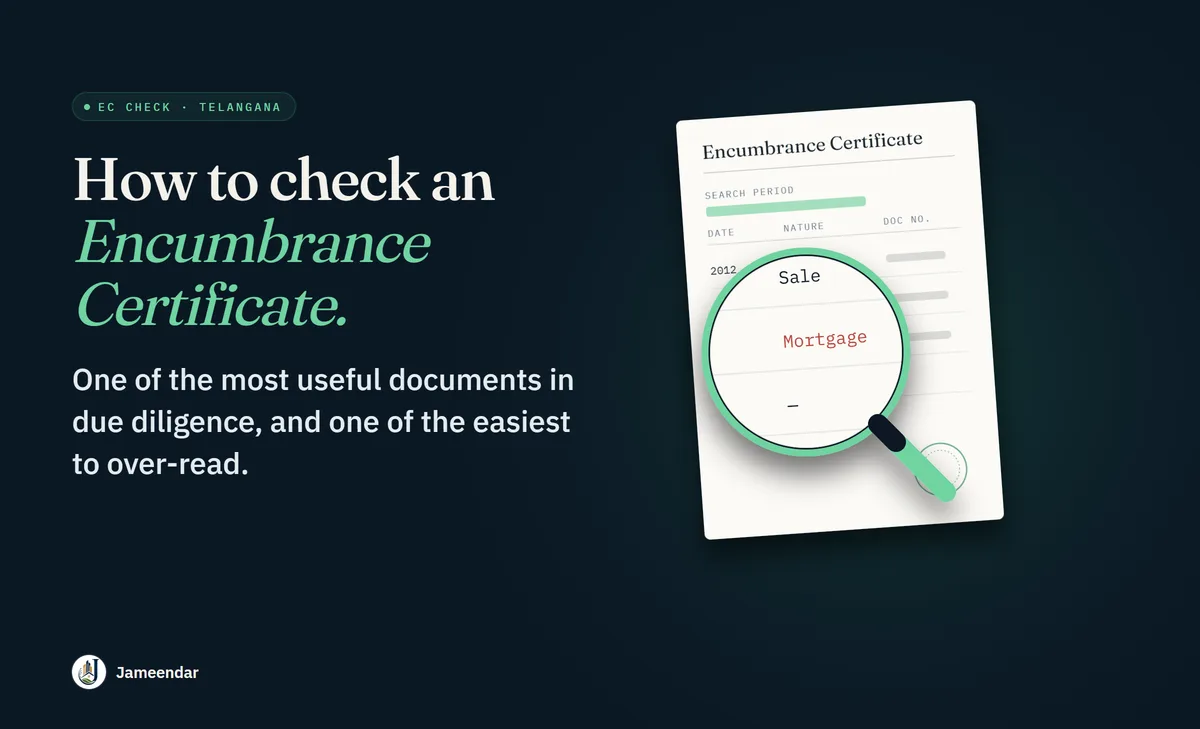
An Encumbrance Certificate (EC) is one of the most useful documents in Telangana property due diligence — and one of the easiest to overinterpret.
The right way to use an EC is as a record of registered transactions found for a selected period. The wrong way is to treat a Nil EC as a guarantee that nobody can ever raise a claim against the property.
What an EC shows
An EC can show registered dealings recorded against the property during the relevant search period, such as sales, mortgages and other registered instruments depending on the record.
It is therefore useful for answering questions such as:
- Has the property been sold before?
- Does a mortgage appear?
- Does the transaction history match what the seller told me?
- Is there a release or other subsequent transaction that needs explanation?
Step 1: Gather the property identifiers
Before searching, collect the district, relevant registration jurisdiction/SRO details, survey or plot information, document number/year if available and the property description.
The better the identifiers, the less likely you are to compare the wrong property.
Step 2: Search through the official registration system
Use the current Telangana registration portal for EC-related services. Basic online search functionality and certified-document procedures can differ, so confirm the current process, login requirements and fees on the official portal when you search.
Do not rely on a screenshot supplied by the seller when you can obtain the record yourself.
Step 3: Choose an appropriate search period
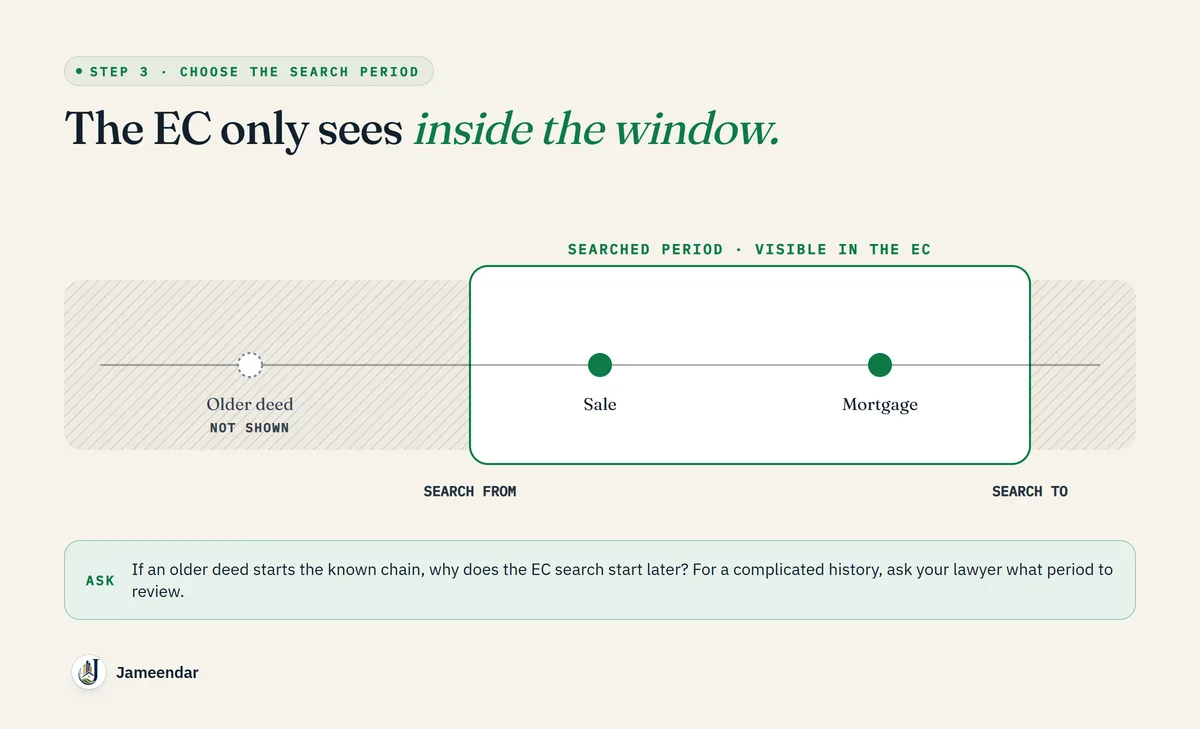
There is no universal “always search exactly X years” rule that works for every property.
The appropriate period depends on the property's transaction history, the age of the title, lender requirements and legal advice.
If an older deed is the beginning of the known chain, ask why the EC search starts later. If the property has a complicated history, ask your lawyer what period should be reviewed.
Step 4: Read every entry against the title chain
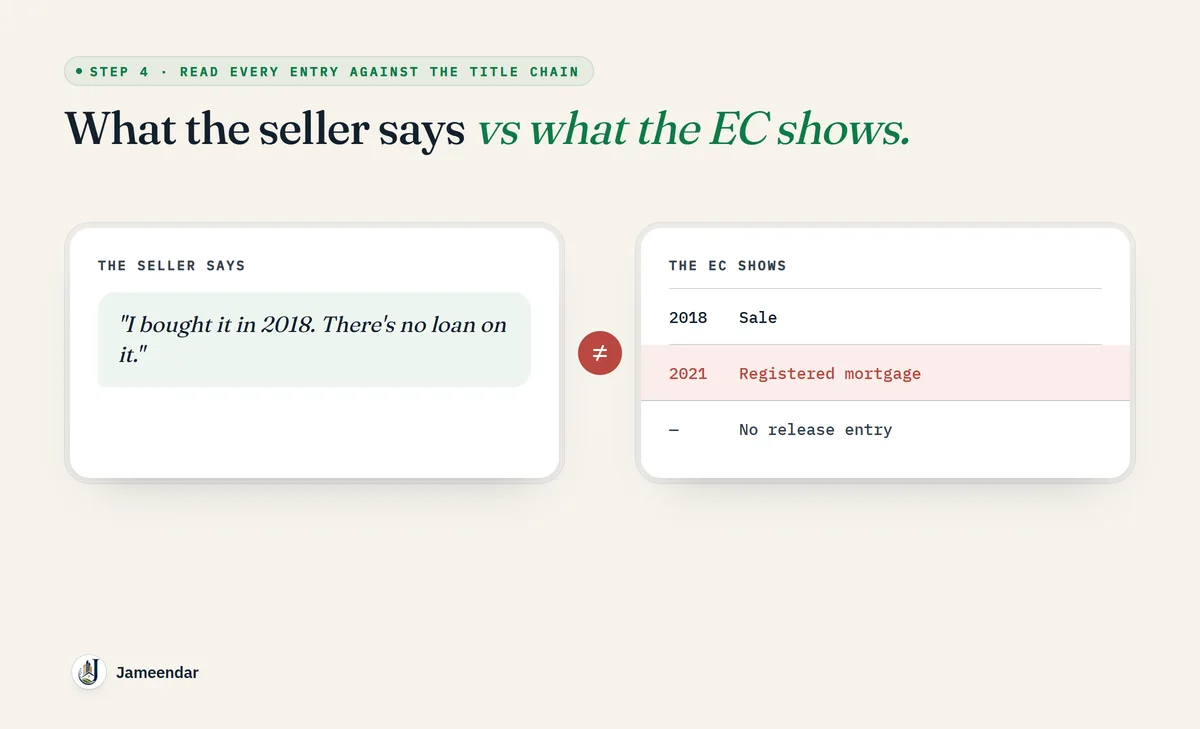
Suppose the seller says the property was purchased in 2018 and has no loan. Your EC shows a registered mortgage in 2021.
That is not a minor discrepancy. You need the mortgage document and evidence explaining its status before proceeding.
The EC should be reconciled with the documents, not read in isolation.
Step 5: Understand what a Nil EC means
A Nil EC means the search did not identify registered transactions within the selected period.
It does not necessarily establish that:
- no unregistered claim exists;
- no litigation exists;
- no issue exists outside the search period; or
- every land/revenue record is correct.
That is why Nil EC is useful but not conclusive.
Step 6: Check land records separately when relevant
Where the property has agricultural/revenue-land history, also examine the current Bhu Bharati land records.
Registration records and land records answer different questions. A buyer who checks only one can miss information in the other.
Step 7: Compare the EC with the seller's documents
Create a simple reconciliation table:
| EC entry | Seller's document | Match? | Action |
|---|---|---|---|
| Sale | Sale deed | Yes/No | Verify |
| Mortgage | Loan/release papers | Yes/No | Verify status |
| Gift/settlement | Supporting deed | Yes/No | Verify |
| Other entry | Underlying document | Yes/No | Investigate |
What if the EC contains an unexpected entry?
Stop before paying more money.
Ask for the underlying registered document. Confirm whether it relates to the same property and whether it was later released, cancelled or otherwise dealt with.
Do not accept “old loan, already cleared” without the supporting record.
Common EC mistakes
Mistake 1: Searching the wrong property identifiers.
Mistake 2: Choosing a search period without understanding the title history.
Mistake 3: Treating Nil EC as clear title.
Mistake 4: Ignoring transactions that do not fit the seller's story.
Mistake 5: Not checking other record systems when the land history requires it.
FAQs
How many years should an EC cover?
There is no universal period. Match the search to the property's history and the requirements of your lawyer or lender.
Does Nil EC mean the property is safe?
No. It means no registered transaction was found in the searched period.
Is EC the same as a title deed?
No. A title deed evidences a transfer or ownership interest; an EC reports registered transactions found in the search.
Where should I get an EC?
Use the official Telangana registration system and confirm the current process and fees there.
What if an EC entry is not explained?
Pause the transaction and obtain the underlying document and professional advice.
Final takeaway
Think of the EC as a transaction-history lens, not a title guarantee.
Use it to cross-check the title chain, then combine it with land records, restrictions, physical verification and legal review.