Assigned Land, Bhoodan Land and Endowment Land Explained
Understand assigned land, Bhoodan land and endowment land in Telangana, why buyers need extra verification and which records to examine.
Jameendar Editorial · · 4 min read
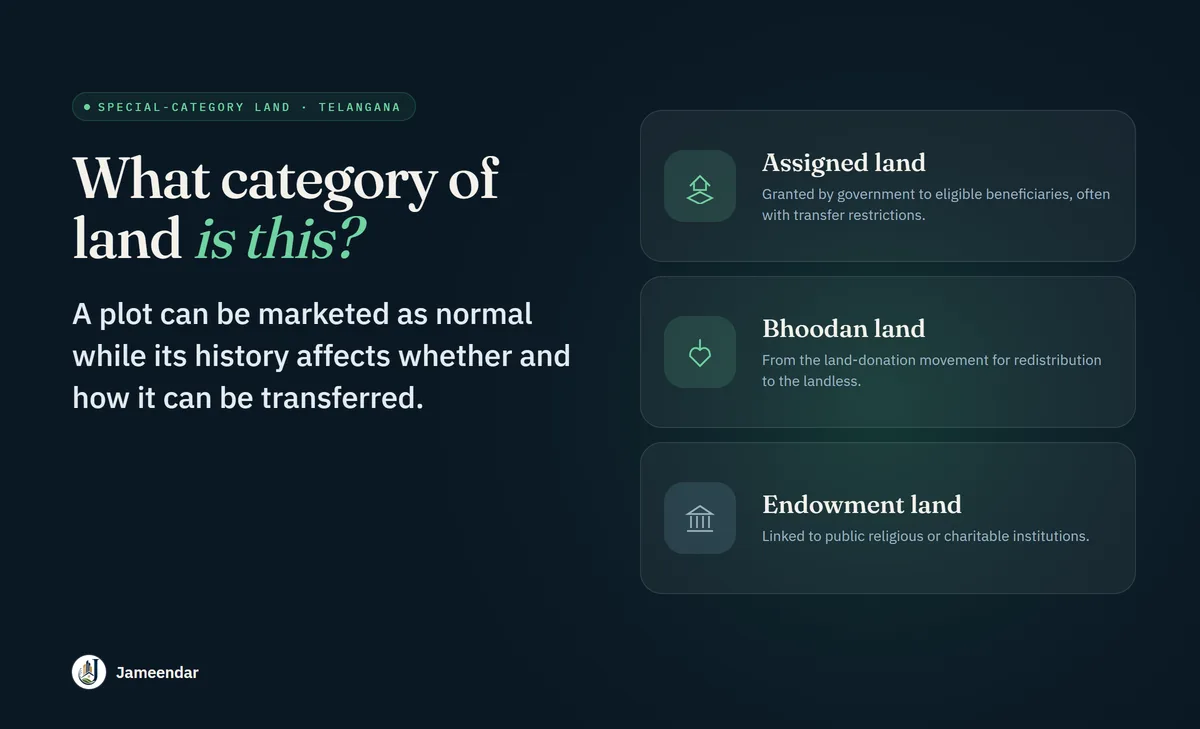
Some of the most important land-verification questions in Telangana begin with a simple question: What category of land is this?
A property may be marketed as a normal plot or parcel, but its historical classification can affect whether and how it can be transferred. Assigned land, Bhoodan-related land and endowment land therefore deserve separate attention during due diligence.
This article is an orientation guide — not a legal opinion on any particular parcel.
1. What is assigned land?
Assigned land generally refers to land granted by the government to eligible beneficiaries under an assignment framework. Telangana has legislation governing assigned lands, including restrictions on transfer.
The key buyer lesson is simple: do not assume that possession, a sale deed or a long transaction history automatically makes assigned land freely transferable.
The exact legal position depends on the nature of the assignment, the applicable law and the property's records.
2. Why buyers should be careful with assigned land
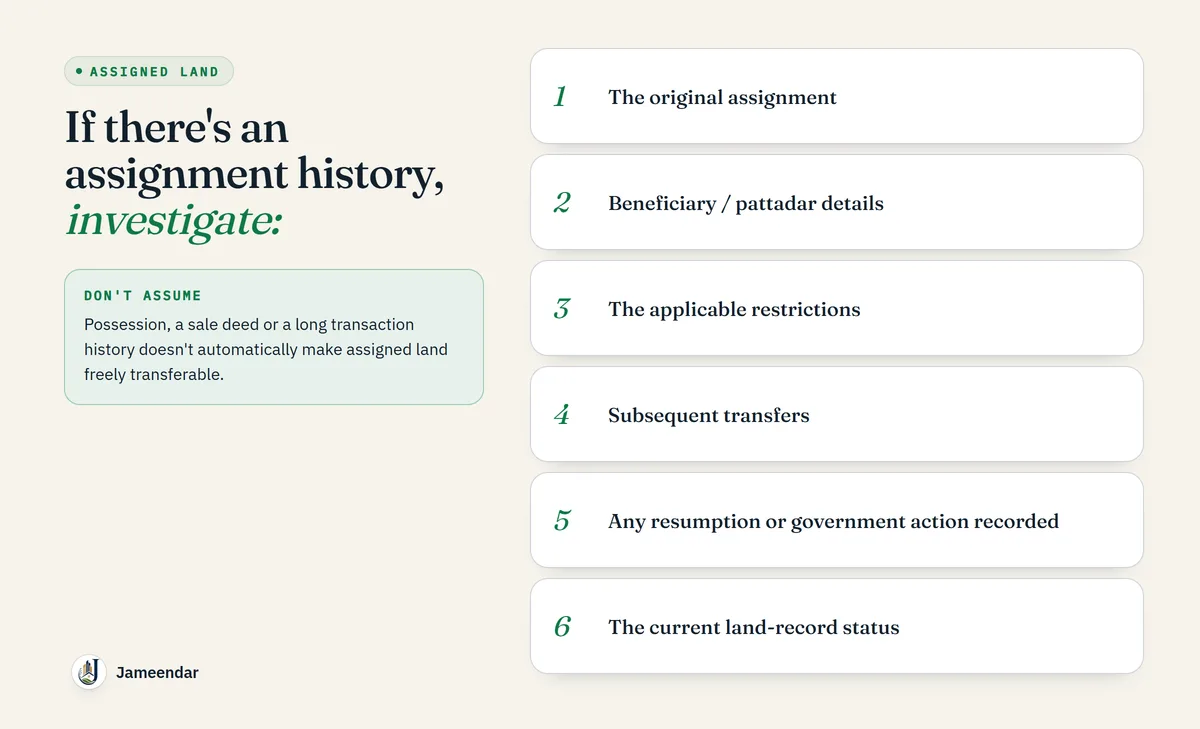
If a property has an assignment history, investigate:
- the original assignment;
- the beneficiary/pattadar details;
- the applicable restrictions;
- subsequent transfers;
- whether any resumption or government action is recorded; and
- the current land record status.
Do not rely only on the seller's statement that “many people have already bought plots here.”
3. What is Bhoodan land?
Bhoodan refers to the land-donation movement associated with Acharya Vinoba Bhave and land donated for redistribution to landless people.
Telangana government material also identifies Bhoodan and Gramadan matters as a distinct revenue/administrative subject.
For a buyer, the historical label is not enough to decide whether a particular parcel can be freely purchased. The actual record history, orders and applicable legal status must be examined.
4. What is endowment land?
Endowment land is associated with public religious or charitable institutions administered under the relevant endowments framework.
The Telangana Endowments Department is responsible for administration and governance of public religious institutions and endowments within its remit.
The practical buyer question is whether the specific parcel appears in the relevant endowment records or mapping/data and what legal status applies to it.
5. Why a normal-looking sale deed is not enough
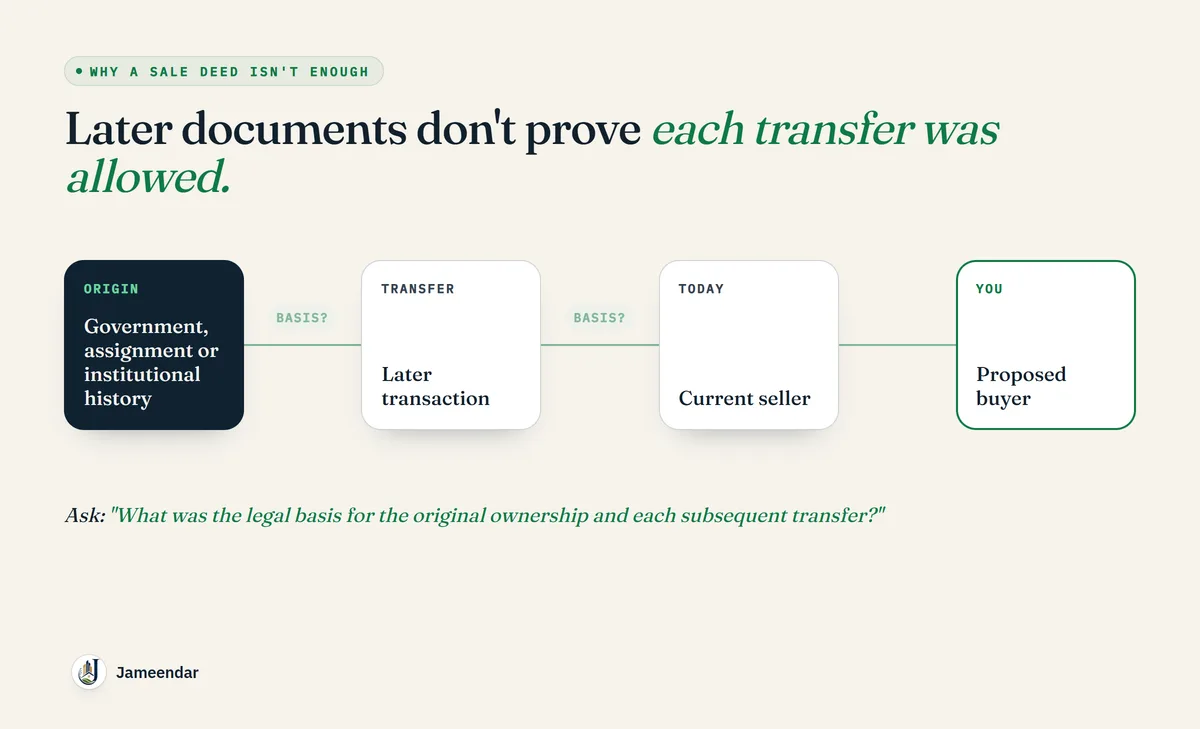
A buyer may encounter a chain such as:
Government/assignment or institutional history → later transaction → current seller → proposed buyer.
The fact that later documents exist does not by itself answer whether each transfer was legally permissible.
This is why special-category land should be reviewed by a property lawyer before an advance is paid.
6. What records should you check?
Start with:
- Current Bhu Bharati land record
- Previous title documents
- Registration history
- Mutation history where relevant
- Prohibited-property status
- Assignment/government orders where applicable
- Endowment-related records where applicable
- Survey and boundary records
- Court orders or litigation information where relevant
Telangana's geospatial resources also expose government datasets/layers relating to endowment lands. Treat such mapping as a verification input and confirm the legal status from the appropriate authority/record.
7. What if the seller says “it is already registered”?
Registration history is important, but it should not end the investigation.
Ask a better question: What was the legal basis for the original ownership and each subsequent transfer?
Where a statutory transfer restriction applies, the existence of later documents does not automatically answer the legal issue.
8. What if Bhu Bharati and the sale deed disagree?
Do not choose the record that supports the purchase price.
Record the discrepancy and obtain the underlying documents. If the conflict concerns classification, extent, ownership or prohibited status, seek professional advice before proceeding.
9. Red flags for special-category land
- Seller refuses to disclose the land's history.
- Assignment documents cannot be produced.
- A government order is mentioned but not shown.
- Survey number appears in a restricted/prohibited record.
- Endowment/institutional ownership is suggested but dismissed without evidence.
- The property has changed hands repeatedly despite an unusual original classification.
- The buyer is told that registration itself “regularizes” everything.
Practical workflow
Identify classification → obtain original/current records → trace transfers → check restrictions → compare survey/extent → check institutional/government records where relevant → obtain legal opinion → only then negotiate.
FAQs
Can assigned land be bought?
Do not assume it is freely transferable. The answer depends on the applicable assignment and law for the specific parcel.
Is Bhoodan land automatically government land?
The historical category does not by itself answer the current legal status of every parcel. Check the actual records and orders.
Can endowment land be sold like private property?
Do not assume so. Determine whether the specific parcel is endowment property and obtain appropriate legal/authority confirmation.
Is a registered deed enough?
No. Special-category land requires verification of the underlying legal status and transfer history.
Final takeaway
Special land categories are exactly where buyers should resist shortcuts.
If a property has an assigned, Bhoodan, endowment or other unusual historical classification, slow down before paying. Gather the records, identify the restriction or legal basis and obtain professional advice on the actual parcel.