FTL and Lake Buffer Zones in Hyderabad: How to Check a Plot Before Buying
What FTL and lake buffer zones mean in Hyderabad, the 30 m and 9 m buffer rules, how to check a plot on the HMDA lakes portal, and what HYDRAA enforcement means for buyers.
Jameendar Editorial · · 7 min read
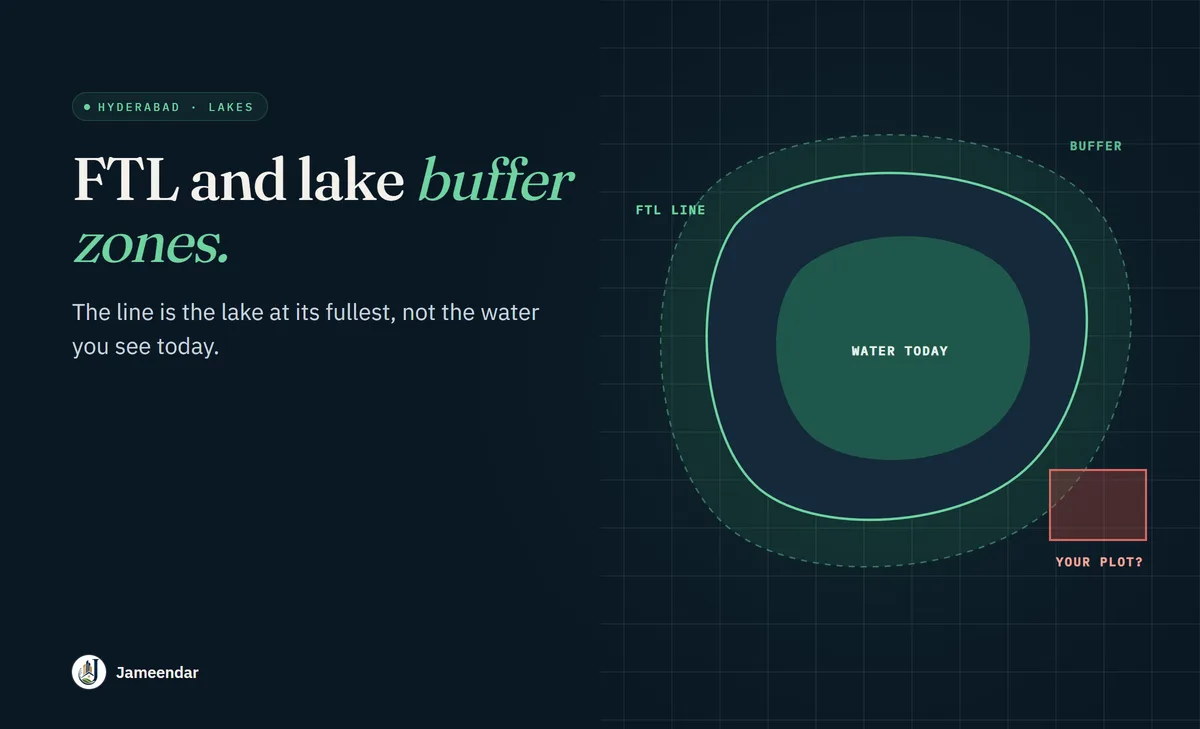
Hyderabad grew around thousands of lakes, and many of them have shrunk as plots and buildings crept onto their beds and edges. Since HYDRAA began demolishing structures inside lake boundaries in 2024, one question now comes before almost every land purchase near water: is this plot inside the lake's Full Tank Level or its buffer zone?
A plot inside either can be refused building permission, and a structure built there can be removed, whatever the sale deed says. This guide explains what the terms mean, the buffer distances, how to check a specific plot on the official map, and what to do when the answer is unclear.
What FTL and buffer zone mean
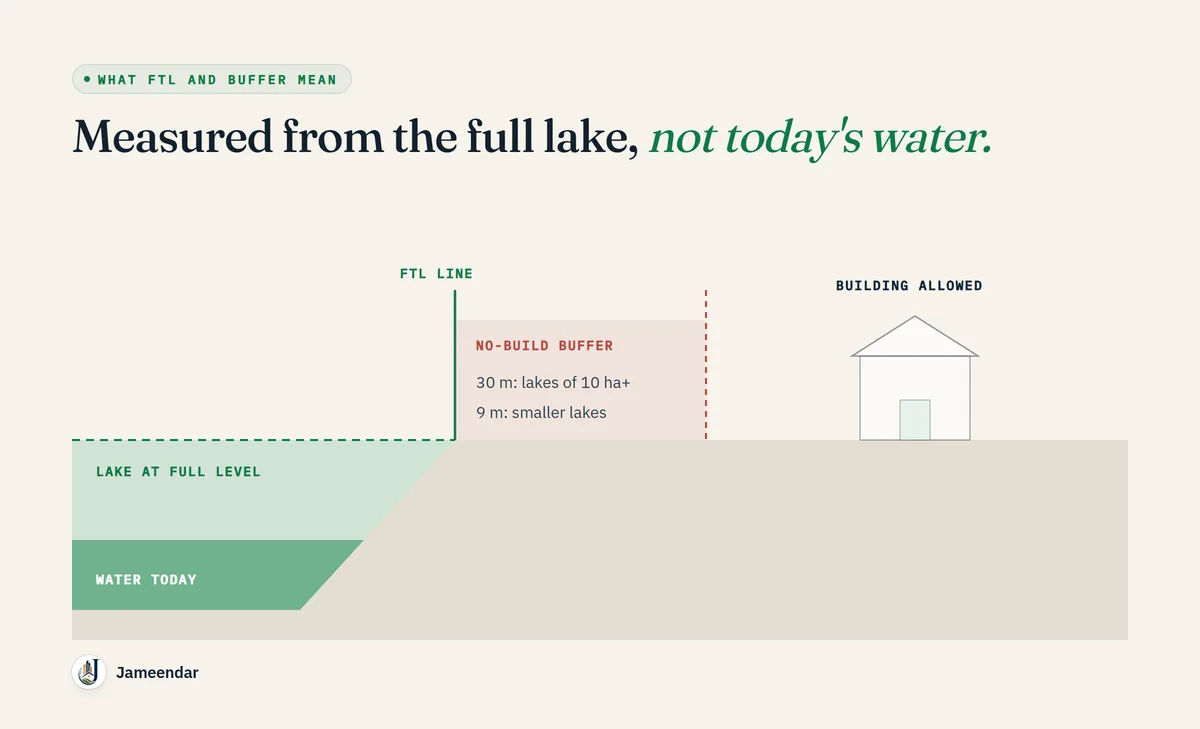
Full Tank Level (FTL) is the line a lake's water reaches when the lake is full. HYDRAA describes it as the maximum water storage capacity of the lake. The land inside the FTL line belongs to the lake, even if it is dry for most of the year. The certified FTL is the one measured by the Irrigation and Revenue departments, not what the ground looks like in summer.
The buffer zone is a strip of land around the FTL line where construction is not allowed. It protects the lake's edge and gives water space to spread in heavy rain.
How wide is the buffer?
Under the Telangana Building Rules (G.O.Ms.No.168, 2012), as published by HYDRAA:
| Water body | No-construction buffer |
|---|---|
| Lake, tank or kunta of 10 hectares or more | 30 metres from the FTL boundary |
| Lake, tank or kunta of less than 10 hectares | 9 metres from the FTL boundary |
Rivers, canals and nalas have their own setbacks, which depend on the type and width of the watercourse, and the official sources state them differently. If there is a nala on or near the plot, get the setback for that specific nala confirmed by the planning authority, and fix where the plot's boundaries actually run on the ground. Our guide to verifying survey numbers and boundaries covers that part.
The buffer is measured from the FTL line, not from the water's edge you see. In a dry season the water can be far inside the FTL, so a plot that looks well away from the water can still fall inside the buffer.
Why this matters more since HYDRAA
HYDRAA, the Hyderabad Disaster Response and Asset Protection Agency, was set up in July 2024. It enforces the ban on residential and commercial development inside FTL boundaries and buffer zones, and removes unauthorised structures built inside them.
HYDRAA's commissioner has repeatedly stated that houses with valid permissions from before July 2024 will not be demolished, while commercial buildings without permission inside the FTL can be removed whatever their age. These are public statements, not a written exemption in law, and reports differ on whether the cut-off is the construction date or the permission date. For a purchase today, do not rely on them. A plot or house you buy now inside the FTL or buffer is a risk you are taking on knowingly.
The practical effects for a buyer:
- No building permission. GHMC and HMDA do not approve construction inside the FTL or buffer.
- Possible removal. Structures inside the lake boundary can be demolished.
- Loans and resale. Banks are wary of lending against property near the FTL, and the next buyer will run the same check you are running now.
- Flooding. Land inside or near the FTL floods when the lake fills, which is why it is protected in the first place.
How to check a plot on the HMDA lakes portal
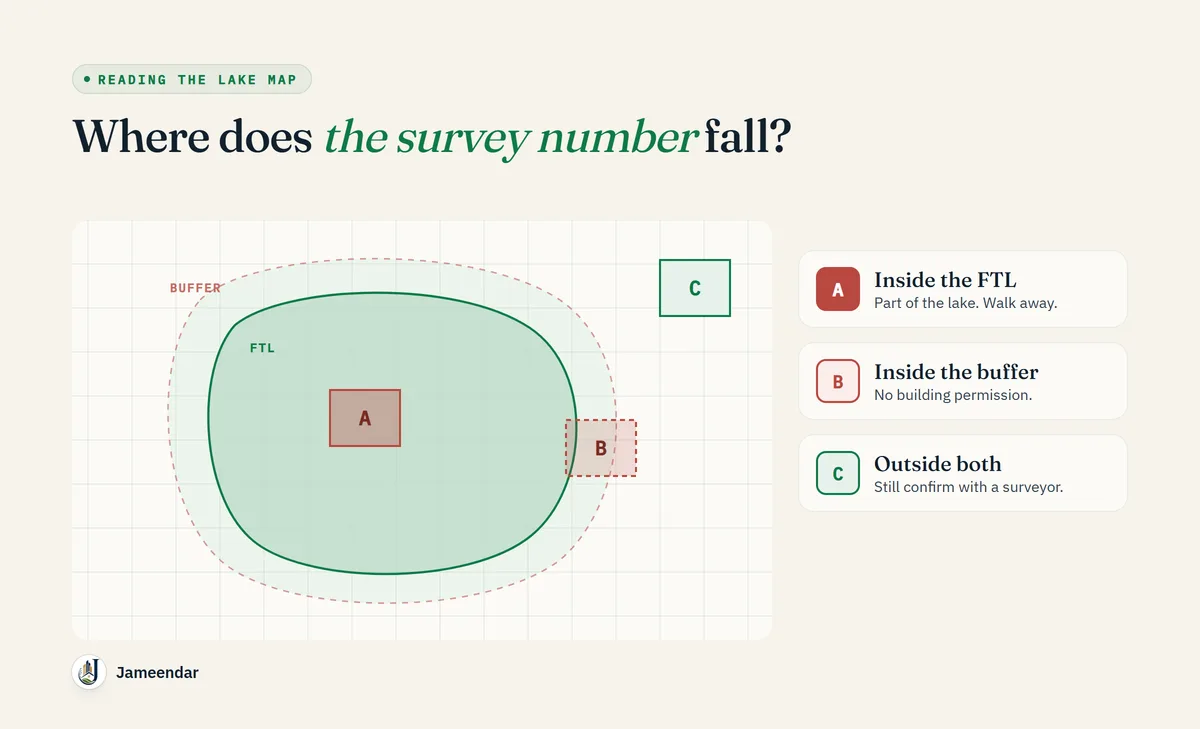
HMDA publishes FTL maps on its official lakes portal, and HYDRAA's own website links to it.
- Get the exact survey number and village of the plot from the sale deed and the land record. Without them you cannot place the plot on the map.
- Find the lakes near the plot. On the portal, select the district, mandal or circle, village, and lake name.
- Open the FTL map and the cadastral map. The portal shows the lake's ID, its FTL boundary and the survey numbers around it.
- Locate the plot's survey number on the map. Note whether it falls inside the FTL line, within the 30 m or 9 m buffer, or outside both.
- Check every lake nearby, not just the biggest one. Small kuntas carry a 9 m buffer and are easy to miss.
- Cross-check the land record. Look up the survey number on Bhu Bharati to confirm its classification. A survey number recorded as tank bed (shikam) land is a red flag on its own.
- Save screenshots with the date. Maps are revised, so keep a record of what you saw and when.
Preliminary vs final notification
Not every lake's boundary is settled. HMDA first issues a preliminary notification of a lake's FTL, invites objections, and only then issues the final notification. Court filings show that a large number of lakes in the HMDA region are still at the preliminary stage, and some preliminary boundaries have been revised.
If the lake near your plot has only a preliminary notification, the line can still move. Treat a plot close to a preliminary boundary as uncertain, not safe.
Signs that need a closer look
- The plot is cheaper than nearby plots for no clear reason.
- The land is low-lying, or water stands on it after rain.
- The layout was approved long ago but nearby construction has stopped.
- The survey number is recorded as tank bed (shikam) land.
- The seller says "the lake dried up years ago". The FTL does not change because the water receded.
- The layout plan does not show the lake or the nala that you can see on the ground.
What to do if the plot is inside or near the line
Inside the FTL: Walk away. Construction will not be permitted, and the land belongs to the lake.
Inside the buffer: Treat it the same way unless a qualified professional confirms in writing, from official records, that the plot is outside it.
Close to the line, or near a lake with only a preliminary notification: Get a licensed surveyor to fix the plot's position against the FTL map, ask the planning authority (GHMC or HMDA) in writing, and do not pay an advance until the position is clear. Our 25 checks before paying a token advance covers how to protect the advance while you check.
Already bought: Get the plot's position surveyed, keep every permission and receipt, and take legal advice before building.
FAQs
What is FTL in Hyderabad real estate?
FTL (Full Tank Level) is the boundary a lake's water reaches when the lake is full. Land inside the FTL line is part of the lake, and construction there is not permitted.
What is the buffer zone around a lake in Hyderabad?
For lakes of 10 hectares or more, construction is barred within 30 metres of the FTL line. For smaller lakes and kuntas, the buffer is 9 metres.
How do I check if my plot is in an FTL or buffer zone?
Use the HMDA lakes portal (lakes.hmda.gov.in) to open the FTL and cadastral maps for lakes near your plot, and locate the plot's survey number on them. Confirm close cases with a licensed surveyor and the planning authority.
Will HYDRAA demolish my house near a lake?
HYDRAA's commissioner has said houses with valid permissions from before July 2024 will not be demolished. That is a public statement, not a guarantee in law. For a purchase today, check the FTL and buffer before buying.
Is the buffer measured from the water's edge?
No. It is measured from the notified FTL line, which can be far beyond the water's edge in a dry season.
Can a lake's FTL boundary change?
Yes. Many lakes have only a preliminary notification, and preliminary boundaries can be revised before the final notification.
Final takeaway
Before buying near any lake in Hyderabad, find the plot's survey number on the HMDA lakes map, check it against the FTL line and the 30 m or 9 m buffer, confirm the land record, and treat anything close to the line, or near a lake with only a preliminary notification, as unresolved until a surveyor and the planning authority confirm it. For the full set of checks, see how to verify a property before buying in Hyderabad.
Sources
- HYDRAA, Asset protection: FTL and buffer zone guidelines.
- HMDA, Lakes portal: FTL and cadastral maps.
- Telangana Building Rules, G.O.Ms.No.168 (2012), buffer provisions.
- National Green Tribunal, O.A. No. 71 of 2023: filings on preliminary and final lake notifications.
- Reports of HYDRAA's statements on pre-July 2024 houses: Siasat (December 2024 and May 2026).
Maps and notifications are revised. Check the official portals at the time of purchase.