HMDA vs DTCP Approved Plots in Hyderabad: Key Differences and Buyer's Checklist
HMDA vs DTCP approved plots in Hyderabad compared on jurisdiction, approval authority and investment potential, plus a 10-point checklist to verify before you buy.
Jameendar Editorial · · 11 min read
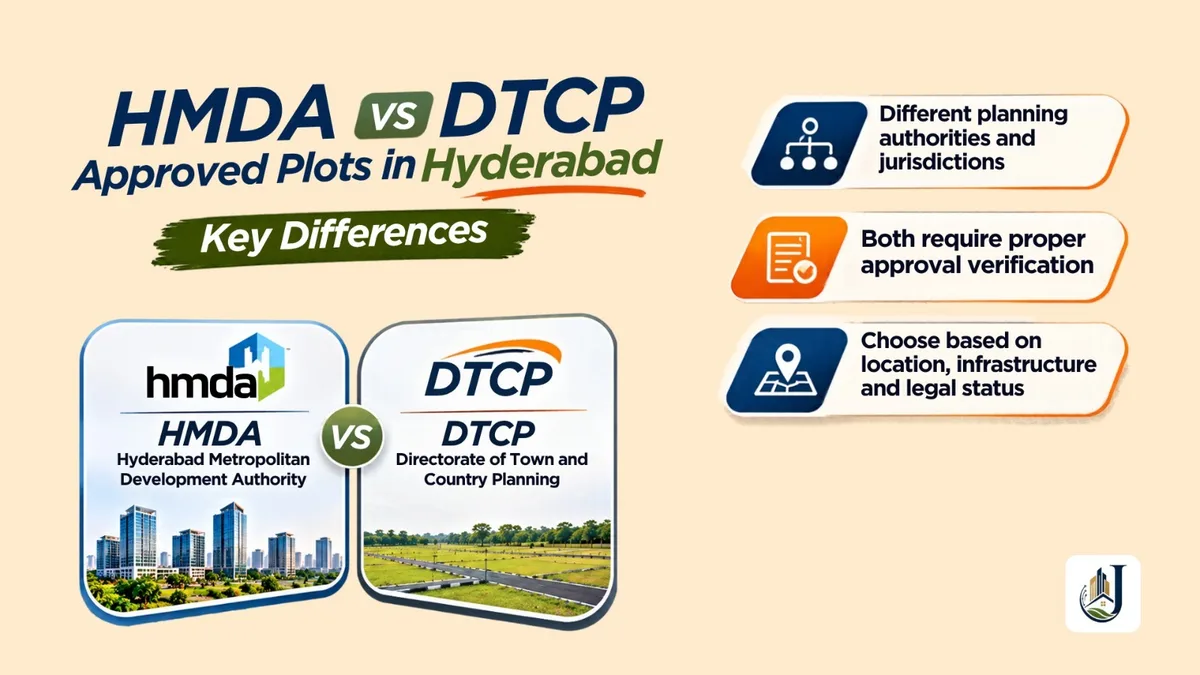
Buying a residential plot in Hyderabad is one of the most popular ways to invest in real estate. With the city's rapid expansion, growing infrastructure and increasing demand for residential land, many buyers are exploring plots in emerging locations around Hyderabad. However, before investing, one important question often creates confusion: Should you choose an HMDA-approved plot or a DTCP-approved plot?
Both HMDA and DTCP approvals are important indicators that a layout has received planning permission from the relevant authority. However, they differ in terms of jurisdiction, approval authority and the locations they cover. Understanding these differences can help buyers make informed decisions and avoid potential legal complications.
Whether you are purchasing a plot for building your dream home or planning a long-term real estate investment, knowing the approval status is essential.
In this guide, let's understand the differences between HMDA and DTCP-approved plots in Hyderabad, their benefits and the important checks every buyer should complete before finalising a property.
What Is an HMDA-Approved Plot?
HMDA stands for Hyderabad Metropolitan Development Authority. It is the statutory planning and development authority responsible for regulating urban development within the notified Hyderabad Metropolitan Region.
An HMDA-approved plot is part of a residential layout that has received the required layout permission from HMDA, subject to the applicable planning regulations and approval conditions.
Before approving a layout, the authority examines several aspects, including:
- Land ownership and supporting documentation.
- Layout design and road connectivity.
- Provision for parks and open spaces.
- Drainage and other infrastructure requirements.
- Compliance with the applicable master plan and land-use regulations.
- Reservation of land for required public amenities.
HMDA approval helps ensure that a residential layout follows the applicable planning requirements.
Why do buyers prefer HMDA-approved plots?
HMDA-approved plots are commonly preferred by buyers looking for residential properties within the Hyderabad Metropolitan Region. They offer greater planning transparency and help buyers identify layouts that have undergone scrutiny by the relevant metropolitan planning authority.
However, HMDA approval alone does not guarantee clear ownership, absence of disputes or freedom from environmental restrictions. Independent legal and property verification is still necessary.
What Is a DTCP-Approved Plot?
DTCP stands for Directorate of Town and Country Planning, Telangana. It is the state-level planning authority responsible for regulating and guiding development in areas under its jurisdiction.
A DTCP-approved plot is located in a layout that has received the necessary planning approval from DTCP or the competent authority under the applicable planning framework.
DTCP approvals are generally relevant to municipalities, towns and other areas outside the jurisdiction of metropolitan or urban development authorities, depending on the applicable government notifications and delegated powers.
The approval process considers factors such as:
- Land ownership and title documentation.
- Layout plans and road arrangements.
- Open spaces and recreational areas.
- Infrastructure and civic amenities.
- Compliance with applicable planning regulations.
- Land-use classification and master plan provisions.
Why do buyers consider DTCP-approved plots?
DTCP-approved layouts can offer attractive residential and investment opportunities in developing towns and locations around Hyderabad.
They may also provide access to locations where land prices are relatively affordable compared with established metropolitan areas.
However, buyers should verify the exact approval authority, approval number and current jurisdiction instead of relying only on the developer's advertisement.
HMDA vs DTCP Approved Plots: Key Differences
Although both approvals are intended to regulate planned development, there are some important differences buyers should understand.
| Comparison | HMDA Approved | DTCP Approved |
|---|---|---|
| Full form | Hyderabad Metropolitan Development Authority | Directorate of Town and Country Planning |
| Authority | Metropolitan planning and development authority | State town and country planning directorate |
| Jurisdiction | Notified Hyderabad Metropolitan Region | Areas under DTCP jurisdiction |
| Primary focus | Metropolitan development and planned layouts | Town and regional planning |
| Location | Eligible areas within HMDA jurisdiction | Eligible areas outside other urban development authority jurisdictions |
| Approval | HMDA layout permission | DTCP or competent authority layout permission |
| Investment potential | Depends on location, infrastructure and demand | Depends on location, infrastructure and demand |
1. Difference in Jurisdiction
The biggest difference between HMDA and DTCP approval is geographical jurisdiction.
HMDA regulates planning and development within its notified metropolitan region. DTCP approval applies to areas that fall under its jurisdiction and are not covered by another competent urban development authority.
One important point: Do not assume that the Outer Ring Road (ORR) automatically determines whether a property requires HMDA or DTCP approval. Jurisdiction can change through government notifications.
Always verify the property's survey number and location against the latest applicable planning authority records.
2. Difference in Approval Authority
HMDA and DTCP are different government planning authorities. They examine layout proposals according to the applicable regulations and their respective jurisdictional responsibilities.
An HMDA approval is not automatically better than a DTCP approval. Similarly, a DTCP-approved plot is not inherently inferior.
What matters is whether the correct authority has approved the layout and whether the approval is valid and final.
3. Difference in Location and Development
HMDA-approved layouts are generally associated with the metropolitan development areas surrounding Hyderabad.
DTCP-approved layouts may be found in developing towns and locations outside HMDA jurisdiction.
For buyers, the better option depends on the property's location, road access, infrastructure, future development plans and price.
4. Difference in Investment Potential
Investment returns do not depend entirely on the approval authority.
An HMDA-approved plot in a poorly connected location may not necessarily outperform a DTCP-approved plot in a rapidly developing area.
Similarly, a DTCP-approved plot with limited infrastructure may take longer to appreciate.
Consider factors such as:
- Proximity to employment hubs.
- Connectivity to highways and major roads.
- Upcoming infrastructure projects.
- Availability of water and electricity.
- Nearby residential and commercial developments.
- Current market rates and future demand.
Remember: Approval establishes planning compliance, while investment potential depends on the property's overall fundamentals.
Which Is Better: HMDA or DTCP Approved Plots?
There is no universal answer. Both HMDA and DTCP-approved plots can be good investment options when they have valid approvals, clear titles and suitable locations.
Choose an HMDA-approved plot if you prefer a property within the notified metropolitan region and find a suitable location with good connectivity and infrastructure.
Consider a DTCP-approved plot if you are exploring developing towns and locations outside HMDA jurisdiction, where land prices and future growth prospects match your investment objectives.
Instead of choosing based only on the approval label, compare the legal status, location, price, infrastructure and future development potential.
Buyer's Checklist: 10 Important Things to Verify Before Buying a Plot in Hyderabad
Even if a developer advertises a property as HMDA or DTCP approved, buyers should independently verify the documents before making any financial commitment.
Here is a practical checklist.
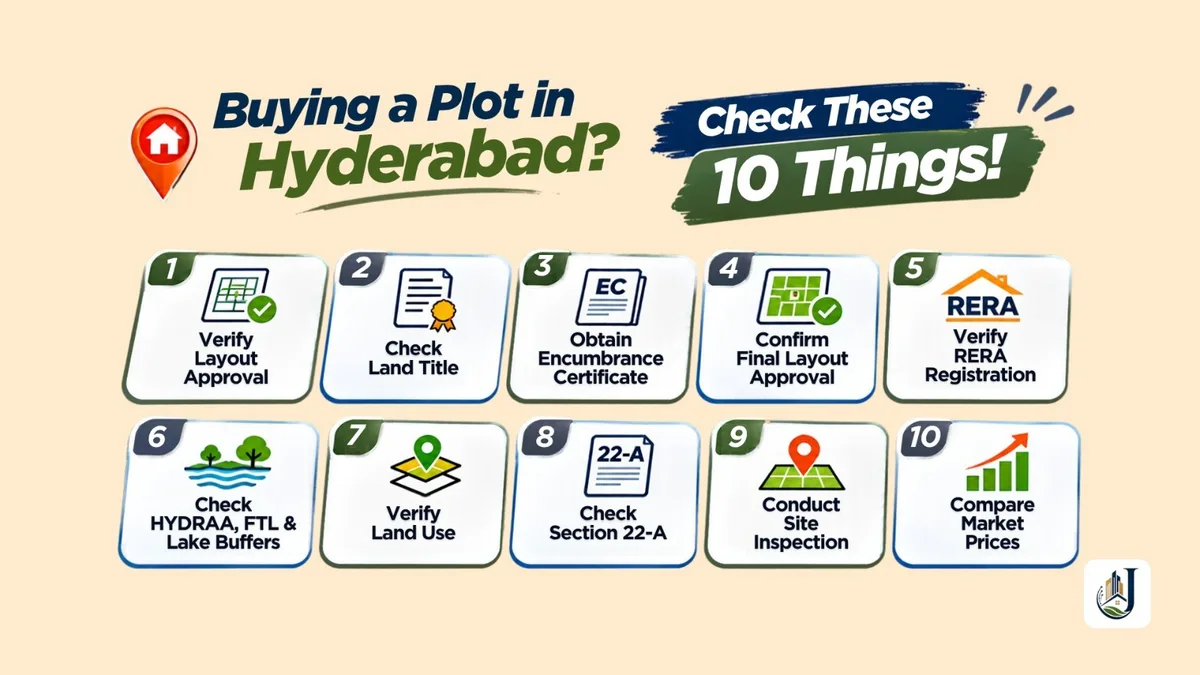
1. Verify the Layout Approval Number
Ask the developer or seller for the official layout approval proceedings and approved layout plan.
Check whether the approval number is genuine and whether the property falls within the approved layout boundaries.
Verify the details with the relevant authority.
2. Check the Land Title and Ownership
A valid layout approval does not automatically establish that the seller has a clear title to the property.
Examine the original sale deed, parent documents and link documents to understand the ownership history.
A qualified property lawyer should review the title chain and identify any ownership disputes or legal complications.
3. Obtain an Encumbrance Certificate (EC)
An Encumbrance Certificate helps identify registered transactions and certain financial liabilities associated with the property.
Check the available transaction history, ideally covering 30 years where records permit. However, remember that an EC does not reveal every possible dispute or unregistered claim. It should be reviewed alongside other ownership documents.
4. Check Whether the Layout Has Final Approval
This is one of the most important steps.
Some developers advertise layouts with tentative or provisional approval. However, tentative approval should not be treated as equivalent to final approval.
In certain approval processes, developers must complete the required development works and comply with mortgage conditions before final release.
Check the final layout proceedings and whether the specific plot is released from any mortgage or restriction.
5. Verify RERA Registration, Where Applicable
The Telangana Real Estate Regulatory Authority (TG-RERA) regulates eligible real estate projects under the applicable RERA provisions.
Check whether the plotted development requires RERA registration and, if applicable, verify its registration number and project details on the official TG-RERA portal.
Do not assume that every individual resale plot requires a separate RERA registration.
6. Check HYDRAA, FTL and Lake Buffer Restrictions
Environmental and waterbody-related restrictions are especially important when purchasing land around Hyderabad.
Verify whether the plot falls within:
- Full Tank Level (FTL) boundaries of lakes or waterbodies.
- Applicable lake buffer zones.
- Nalas and drainage channels.
- Government-identified restricted or protected areas.
Check the relevant government records and maps, including available HYDRAA information.
A layout approval should not be treated as a substitute for checking current environmental restrictions.
7. Verify the Land Use Classification
Check whether the land is classified for residential use under the applicable master plan.
If agricultural land has been converted for non-agricultural purposes, verify the relevant land conversion permissions and records.
The property's permitted use should match your intended purpose.
8. Check the 22-A Prohibited Property List
Section 22-A of the Registration Act deals with specified categories of properties that are prohibited from registration.
Check whether the survey number or property appears in the applicable prohibited property records.
Do not proceed without resolving any discrepancy or restriction.
9. Conduct a Physical Site Inspection
Never purchase a plot based entirely on brochures, online photographs or location maps.
Visit the property and verify:
- Actual plot dimensions and boundaries.
- Road access and road width.
- Physical possession and possible encroachments.
- Nearby drainage and water facilities.
- Surrounding development.
- Availability of electricity and water connections.
A licensed surveyor can help confirm the actual measurements and boundaries.
10. Compare the Market Price and Registration Details
Compare the quoted price with prevailing market rates in the surrounding locality.
Check the applicable government market value, registration charges and other transaction costs.
Avoid paying an advance based only on promises of future appreciation or guaranteed returns.
Common Mistakes to Avoid When Buying Approved Plots
Even experienced buyers can overlook important details while purchasing land.
Avoid these common mistakes:
- Assuming HMDA approval automatically guarantees a clear title.
- Treating tentative approval as final approval.
- Believing that Gram Panchayat permission alone is sufficient for a plotted layout.
- Ignoring FTL, lake buffer and nala restrictions.
- Not checking the property's survey number against official records.
- Purchasing without reviewing parent documents and the EC.
- Trusting verbal promises about future infrastructure.
- Paying a booking amount without checking the legal documents.
The Telangana government's Layout Regularization Scheme (LRS) FAQs also clarify that Gram Panchayat approval without the required technical approval from the competent planning authority does not make a layout valid.
Therefore, proper document verification should always come before payment.
How Jameendar Helps You Find Verified Plots in Hyderabad
Finding a plot is easy. Finding a plot with verified documents, transparent ownership information and fewer legal uncertainties requires much more attention.
This is where Jameendar helps property buyers make informed decisions.
Jameendar is designed to simplify property discovery and verification through technology-driven checks and transparent property information.

Before you shortlist a property, Jameendar focuses on important verification aspects, including:
- Title Verification: Reviewing ownership details and available land records.
- RERA Compliance: Checking applicable project registration details.
- Encumbrance Verification: Reviewing available EC records to identify registered transactions and liabilities.
- HYDRAA and Buffer Checks: Assessing available information relating to lake FTL boundaries and buffer restrictions.
- Section 22-A Verification: Checking relevant prohibited property records.
- Location Intelligence: Understanding the property's surroundings and development context.
- Jameendar Trust Score: Bringing multiple verification indicators together to help buyers understand potential property risks.
Through its AI-powered property discovery experience and Bhoomi AI, Jameendar aims to make property research more accessible and transparent.
However, technology-assisted verification should complement, not replace, official record confirmation and independent legal advice.
Explore verified property opportunities at jameendar.com and make informed decisions before investing in Hyderabad real estate.
Frequently Asked Questions (FAQs)
Is HMDA approval better than DTCP approval?
Not necessarily. Both are valid planning approvals when issued by the competent authority for the relevant location. The better investment depends on the property's location, infrastructure, title and market potential.
Can I construct a house on a DTCP-approved plot?
Generally, yes, subject to the layout's valid approval status, permitted land use and obtaining the necessary building permission from the competent local authority.
Are Gram Panchayat-approved layouts safe to buy?
Not automatically. Gram Panchayat approval alone, without the required technical approval from HMDA, DTCP or another competent planning authority, does not establish a valid layout approval.
Does HMDA approval guarantee a clear property title?
No. HMDA approval relates to layout planning permission. Buyers must separately verify ownership, parent documents, EC, litigation history and other applicable legal records.
Is RERA registration compulsory for every plotted layout?
No. RERA registration requirements depend on the nature, size and applicable exemptions of the real estate project. Buyers should check the relevant project details and applicable provisions.
What is the most important document to check before buying a plot?
There is no single document that establishes complete legal safety. Buyers should examine the registered sale deed, parent documents, EC, layout approval proceedings, final approval status, land-use records and other applicable clearances together.
Final Thoughts
Choosing between HMDA and DTCP-approved plots in Hyderabad is not simply about selecting one approval over another. It is about understanding the property's location, planning authority, legal status and long-term potential.
Both types of approved layouts can offer worthwhile opportunities when the correct permissions are in place and the underlying land records are clear.
Before investing, verify the approval number, title documents, EC, final layout status, RERA applicability and HYDRAA-related restrictions. Most importantly, never rush into a transaction based only on a developer's claims.
Looking to buy a plot in Hyderabad? Explore property opportunities with Jameendar, review important verification details and make your next real estate decision with greater confidence.
Visit jameendar.com to explore properties and discover a more transparent way to buy real estate.